Moving On from Koh Chang

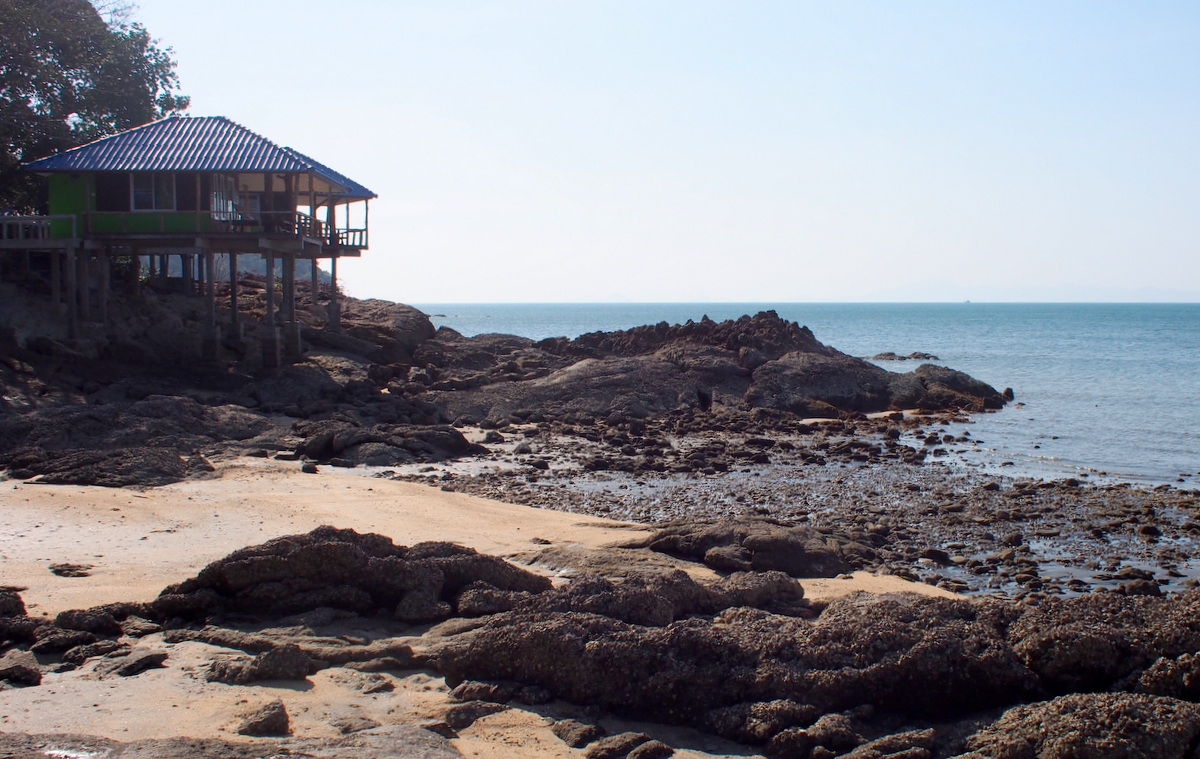
Our bungalow on stilts

Our bungalow on its tall stilts

And already, after just four days, we’re packing up. It’s beautiful here on Koh Chang but it wouldn’t be island hopping without some hopping. So, tomorrow, we’re getting on a speedboat and heading off to Koh Phayam, just a few miles to the south of here.

It’s hard uprooting ourselves. Not least because within moments of arriving anywhere, our rucksacks are empty and our room is suddenly stuffed with clothes, sarongs, hats, a kettle, tea cups, tea (Earl Gray and redbush – thanks, Mum!), sun lotion, a medical bag, a wash bag, a dirty washing bag, packing cubes, games, cards, diaries, pens and pencils, school books, various electrical gizmos, cameras, a multitude of chargers for the gizmos and cameras, inflatable mattresses, sheets, snacks, bottled water and all the other paraphernalia apparently essential to travelling light. It’s surprisingly easy to unpack all that stuff. And surprisingly daunting to somehow fit it back into our bags.

Whenever we stay still too long in any place where there’s not much more to do than wander the same jungle paths or strip of beach, a Groundhog Day effect comes into play, each day blending with the one before. The later days offer diminishing returns of experience.

And, I’m pretty sure there’s something psychologically beneficial to moving on like this. It’s not the house that makes a family. And it’s comforting knowing that we can survive in relative comfort with just what we carry. Or maybe not. Maybe it makes us feel rootless and unconnected and we’ll return to the UK psychologically shattered. I don’t know.

Whatever. We’ve decided to island hop, so it’s time to move on.

Most importantly, though, even more so than the impending mega-pack and possible psychological implications of abandoning the comforting familiarity of our resort, I have a very practical reason for wanting to move on. Our bungalow is one of the most dramatically-located we’ve yet inhabited. It’s perched atop stilts over a rocky outcrop jutting out to sea, directly facing the amazing sunsets you get here. As you sit on the decking, the waves lap the rocks below, crabs shuffling among rock pools. It’s stunning.

But it also scares me. We’re just recovering from one disastrous five-metre fall, and the balcony rail here is so low that every time my girls stand near it I find myself tensing to sprung and catch them should they fall. Even with strict warnings about acting sensibly near the edge (together with constant reminders), I just cannot quite relax. The rocks below are sharp, and of course, very hard.

I really don’t want any more accidents. And Koh Phayam looks like it has very soft beaches.

Island Life

It’s taken a while, but finally we’re here. We’ve travelled for well over a week from Laos to get to this island off the Andaman Coast (although admittedly with a few stop, first to get Scarlett’s cast removed, then to idle in Prachuap Khiri Khan), but now we’re ready to start our two month, 300-mile, island-hopping tour down to Malaysia. The island is Koh Chang, the northern-most island on the West coast (not to be confused with the more famous Koh Chang on the Gulf of Thailand).

As I write, I am lying in the Mexican hammock my dad bought me before my first backpacking trip in 1999, a brilliant present that proved invaluable to loafing around Thailand then and is just as seductively comfortable now as it was all those years ago (provided that three 8-year olds aren’t also trying to fit into it – fortunately they’re all now asleep). The day’s two-hours-per-day of electricity are over and, as the waves lap around three sides of our bungalow that hovers over the bay on stilts, I can either look across the sea to uninhabited, jungley Burmese islands, with fewer lights than any country I‘ve ever known, or up, to see more stars than are ever visible at home. This finally feels like being in the Tropics. This is the first time I’ve strung it in all the places we’ve visited this time. Finally I feel like I’m back to the Thailand I once knew.

I’d begun to think that this Thailand had vanished. In 1999, Janet and I backpacked for a year around Thailand. We never booked ahead. And we mostly paid £2-3 a night for flimsy bamboo bungalows, and maybe 30-40p for meals.

Even then the bamboo beach hits were fast disappearing in Koh Samui but it seems now that they are relics of a bygone age. And we find ourselves rarely spending less that £20 for a room nowadays (and nearer £2 each for food). Sure, we need spacier accommodation with 5 of us to squeeze in, but Thailand has moved on in 15 years. There are a lot more tourists, Thais are wealthier and the bungalow operations realise they can get a lot more for their beachfronts.

Still, the places we’ve visited have perhaps not been representative. Koh Samui, Koh Tao, Pattaya, Hua Hin: we’ve somehow made our first month and more a tour of the most developed resorts in the whole country. And, Koh Tao apart, these aren’t the kind of places we dreamt of revisiting.

But now… little Koh Chang. No bamboo beach huts, perhaps, but hammocks, lapping waves, sunsets, starlight, no electricity; just cheap food, warm seas and wonderful beaches. This is the Thailand I loved.

I hope the next two months can live up to its promise.

Cast On, Cast Off

This slideshow requires JavaScript.

So, after a nearly 30-hour journey, and with the aid of one tuk-tuk, one songtiaw, one taxi, one night train, one day train, two long distance buses and a fair bit of walking (sometimes even in the right direction), we have made it from Savannakhet in Laos to Hua Hin on the Gulf of Thailand.

We got a 60 day visa for Thailand this time round and are planning to spend the next two months almost entirely on Southern Thailand’s beaches and islands, heading on to Malaysia in late March. But before that starts, we’ve stopped in Hua Hin for a very important hospital appointment: tomorrow Scarlett gets her cast off!

She broke her leg on November 13th and it’s been a long, hard 10 weeks. At first she couldn’t sleep, then she couldn’t walk, then she couldn’t play with her sisters at all, then she couldn’t keep up with them on her crutches, then she couldn’t swim, but through it all, she’s been ever-so brave, hardly complaining through not only all that us dragging her half way across Asia.

But tomorrow (fingers crossed) there will be no more cast, no more complicated waterproof cast covers, no more dreadful itching and blisters where the cast rubbed, no more sand or stones to extricate, and no more carrying her up stairs (when she’s tired) or across beaches (when she has no cast cover on).

She’ll be mobile again and able to make the most of her travels.

All of which I’m glad for. Although I will rather miss the carrying her around in my arms bit.

The Musée des Dinosaures, Savannakhet

When we arrived at the Musée des Dinosaures in Savannakhet, I wasn’t expecting much. It warned our guide book that there were just a couple of rooms and the whole place was obviously underfunded but that it had displays from several local digs where they’d found bones from t-rexes, spinosauruses, several sauropods and even a newly-identified species found only here in Laos.

Personally, I’m fond of small museums. They often have a bit of character and can generally be relied upon to throw up some surprises as the curators struggle to fill them up. Plus you don’t risk the kind of foot-punishing, brain-numbing museum fatigue delivered by bigger places. And sure enough, the exhibits were limited to several bones from a sauropod, together with a fairy-lit outline on the wall to show how they fitted together and a dozen or so display cases of other finds, together with some unusual rocks and a meteor.I’m pretty sure it wasn’t a fragment of the meteor that wiped out the dinosaurs but, hey, who can argue with seeing a meteor.

Anyway, it was all interesting enough and with half an hour or so killed in discussing paleontology and meteors, we were ready to leave… when the curator stepped out of a doorway, somewhat like the shopkeeper from 70’s kids’ TV show Mr. Ben, and asked if we would like to see some more bones.

“OK,” we replied, so he opened a drawer.

“This bone from Tyrannosaurus Rex,” he said, lifting a cannon-ball sized lump out of the drawer. “You want to hold?”

And that was it. I had in my hands a real T-Rex bone. Not a plaster-cast replica. The real thing.

I couldn’t believe it. A 65-million plus year old relic of another aeon. In my hands.

And then it got better. He took us into the back where they clean their finds and showed us more bones, letting us hold them each time. He showed us the plaster casts they were making for a Thai museum, the tools they use and the display they were putting together for their newly-identified species.

But through it all, and long after we left, it was the T-Rex bone that I kept thinking back to. The museum here may be tiny, but you don’t get experiences like this at the Natural History Museum.

Travelling with Triplets

Exploring Koh Samui

A surprised double take. Wide eyes. “Fet Sam?” (That’s “Three twins?” in Thai. There’s no special word for triplets. I guess they’re too rare.)

I smile proudly. “Fet sam.” (“Yes, three twins”)

A closer look, one girl at a time. Then awe-struck agreement. “Aaw! Fet sam.”

She looks around, wondering who else to tell. A thrilled whisper follows if there’s someone nearby but if the nearest person is over the street, a discovery like this is too exciting not to be shouted across. “Fet sam!”

And it starts again. The newly-engaged stranger widens their eyes. They double take. And, disbelieving: “Fet sam?”

“Fet sam,” the woman confirms.

They turn to me. “Fet sam?”

I confirm it, too. “Fet sam.”

Wonder! “Aaw! Fet sam!” And a look around for someone who hasn’t yet heard the news.

Another shout to another stranger. “Fet sam!”

Another double take. Another query, first to their informant, then the general public around them, then me.

“Fet sam?”
“Fet sam.”
“Fet sam?”
“Fet sam.”
“Fet sam?”
“Fet sam.”
“Aaw! Fet sam.”

There’s no need for conversation starters when travelling South-East Asia with triplets. Wherever we go, they’re a sensation. But somehow, it never feels intrusive. No one stops us if we’re in a hurry. The wonder is genuine.

And when you’ve come to stare at someone else’s country, it’s only fair that they look back, too.