
The rating system in our current hotel in Labuan Bajo seems a bit harsh…

The rating system in our current hotel in Labuan Bajo seems a bit harsh…
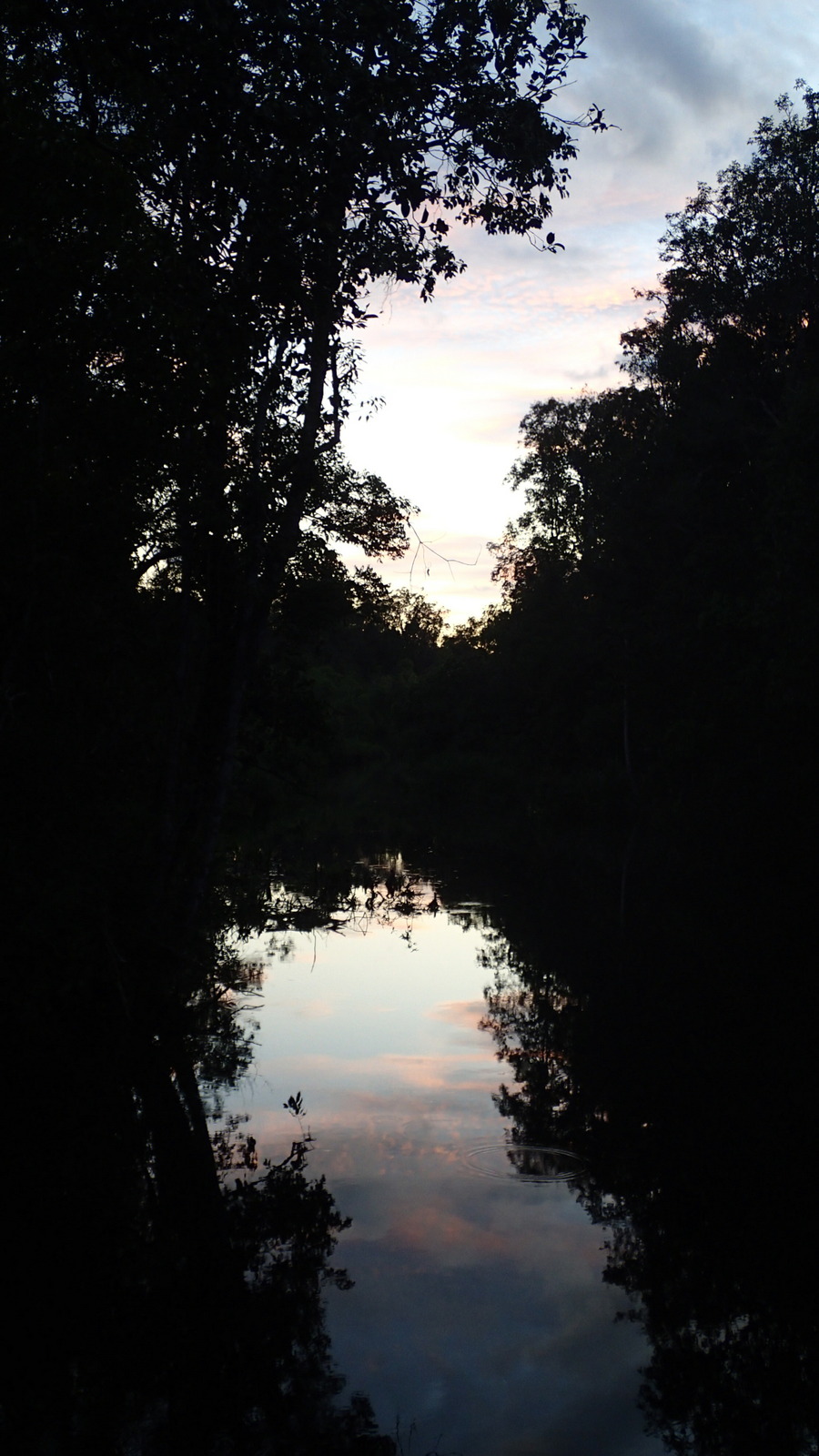
It’s early morning – not even five-thirty – and I’m standing alone on the open deck of our klotok, the wide-decked, open-sided river boat we’ve hired for three days of travel deep into the jungles of Borneo. I feel a very long way from home.
All around, the river water is a peaty red, darkening to glossy black away from the banks where it flows smoothly past our mooring. The blackness is broken only by the reflection of the brightening sky and the occasional deep splash of a surfacing fish. With each splash I turn quickly, hoping I’ll see one of the crocodiles that ate the traveller who ignored warnings not to swim on this very spot a few years ago. I don’t see any but that doesn’t mean they aren’t nearby. The shadows, reeds and fallen trees along the banks could easily hide a dozen crocodiles.
My eyes search the thick jungle swamps on each bank. There are macaques here. I can hear their woo-wooing nearby but haven’t managed to spot any yet. Not that I’m surprised. Their fur blends perfectly with the soaring white-grey tree trunks. Nor have I seen kingfishers, fly-catchers, hornbills, tree frogs, proboscis monkeys or any of the other thousands of species that make this a “biodiversity hotspot”. Only the insects are visible this morning; dragonflies the length of my middle finger, bees, beetles and smaller, indeterminate creatures I hear as passing buzzes beside my ear. And if our trek into the jungle yesterday is anything to go by, I wouldn’t have to go far from our boat to find thick columns of termites or wild, dangerous scatterings of the fire ants that we all fell painfully prey to.
But I don’t mind that I can’t see anything just now. The forest is alive with life. I can hear it. And somehow, gazing out into the confusion of trees, vines, ferns, water plants and bushes, ears alight with whoops, clicks and bird calls, this feels like the most natural state in the World; in distinguishing the complexities of these sights and sounds, I feel my brain slipping into its natural gear. There isn’t a straight line in sight, nor a single colour that diverges from the forest’s natural greens, greys and browns, except with reds and blacks of the water below and the blue of the lightening sky.
I wonder if any of the orangutans we saw yesterday are nesting nearby. And whether this sensation of oneness and peace is how they feel. Their slow, measured gazes and the way they swing through the treetops at whatever speed each tree bends under their weight seemed to imply so.
We’re moored at Camp Leakey, the longest-running research station in the World, where for the last 40 years , Dr. Galdikas has been observing wild orangutans as well as rehabilitating captured ones.
These thoughts are heightened by the thrill of being so far from civilization. There isn’t a hospital for many hundreds of miles and few roads through the jungle on which to reach one… well, except the charity-run orangutan hospital half-way up-river. I guess they could probably set a broken bone at a push.
It took two full days to get here but today we’ll turn our klotok around and begin the return journey, stopping to visit one more orangutan feeding station on the way. This is the remotest place we’ll visit on our travels. From here on we’ll slowly be returning to modernity.
I was going to end there, leaving this post as an elegy on Man’s Primal Being, Oneness With Nature and other romantic daybreak thoughts. But then…
With a crash, a tree beside us swung forwards, showering leaves onto the river. For a moment I couldn’t see what had caused the sudden commotion. The jungle fell silent. Then, the tree snapped back, the leaves spread out into the current, leaving a single, large orangutan a few metres from where I stood. He watched me. I watched him. As entrances go, I had to admit it was impressively dramatic. Then he swung over to where our boat’s mooring rope secured us to a fallen tree.
Was he going to pull us to shore? Come aboard? He gave the rope an exploratory tug but our klotok is big and would have needed a much more serious effort to shift. Looking disappointed, he gave up and climbed onto a comfortable-looking tree, descending occasionally to pick a pandanas shoot or fish a discarded piece of fruit from the water.
Slowly, the rest of our family awoke, drifting forwards to join the mutual contemplation, orang1 and orangutan.
Then the other klotok moored nearby woke up, too, and began calling and throwing watermelon rinds into the river. The spell was broken; the orangutan moved off and we retreated inside for a breakfast of our own.
[1] In both Indonesian and Malay, orang means “man”. Orang utan means “man of the forest”.
You spend a lot of time while travelling staring out of the window of your bus, train or other, less comfortable transportation, so when you see something written in English it’s a pleasant surprise. I always feel like it might give me some insight into the place I’m passing through.
These three signs are all from the Philippines. I wonder what they reveal about the people who live there.
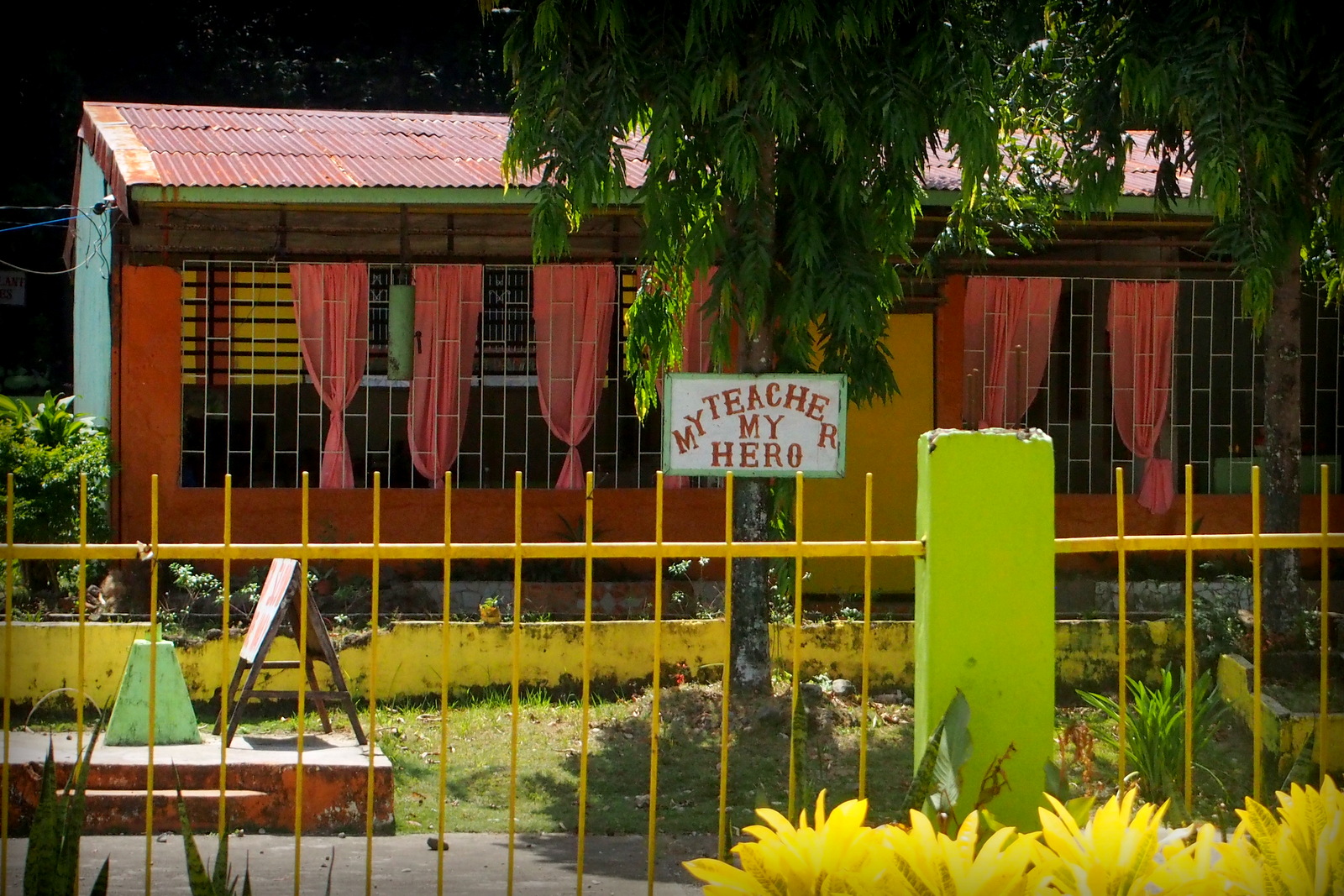
I saw this one outside a remote village school on Negros. Despite all the houses nearby being little more than ramshackle lean-tos ith ragged cloth or plastic sheeting for doors, the school was carefully painted, planted with shrubs, had cut grass and home-made, wooden toys in the schoolyard. Clearly someone had taken enormous pains to give the kids in that village somewhere pleasant to learn in. Then I saw the sign.

These signs were all along the road leading to a high school elsewhere on Negros. Clearly the locals are trying to keep drugs out of their school. And why let the truth stand in the way of a good cause.
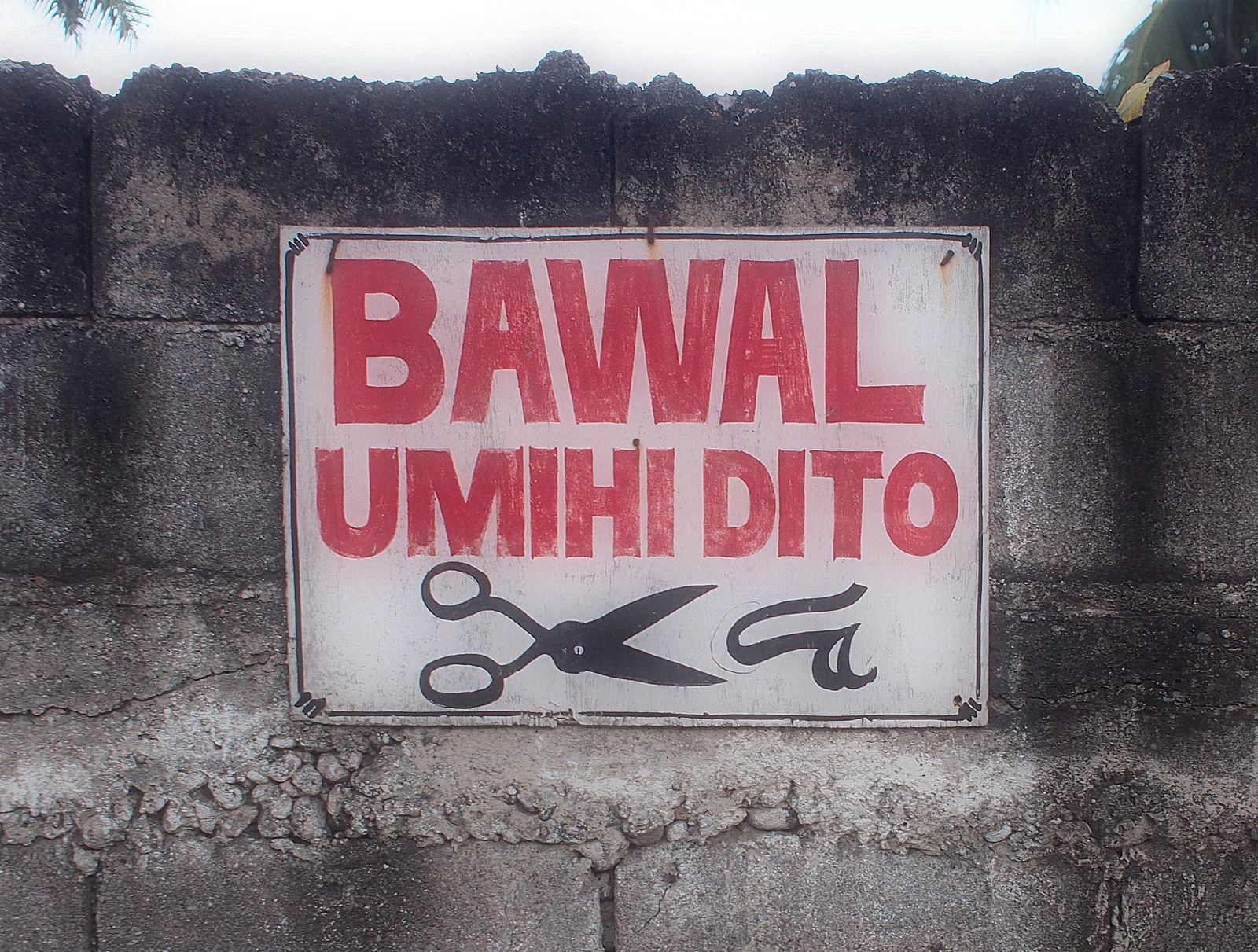
This was on a wall in Dumaguete. I have no idea what the words mean. And I really hope that image next to the scissors is a pointing finger.

Two very exciting events have just combined. For the first time in any of our lives we are south of the equator. And our hotel room has a bath.
Time to go and watch the water spin the wrong way down the plug hole.
After a long laze in Sipalay, we wanted to speed things up a bit, but – wow! – the last three days on Sequijor have been so incredibly full that I could fill a blog post about each, individually. However, it’s getting late and we’re packing up and moving on tomorrow so I guess I’ll just get it all down as best I can before my kids come running back from the coconut trees on the beach to tell me how starving they are and none of it gets written down at all.


On our first day here on Sequijor, we decided to go exploring. Wandering up to the main road, we hailed a tricycle (a Philippine euphemism for a rattle-engined motorbike with equally rattley home-made sidecar) and asked the to take us round the island, stopping at the sights. It was awesome!
We visited a local park in St. Juan with a “swimming pool” (pond) where the girls swam. We stopped at some beautiful, 4-level waterfalls where we all swam, including swimming right under the falls into a hidden cave behind.
Then a coastal resort where they had built water slides and diving boards into towering cliffs over the sea. The slides were closed and partially collapsed, an unfortunate testament to ambition over realisation, but the diving boards were relatively stable-looking, so we climbed up and had a look over the edge. It was a long way down. The kind of long way that made the 10m board at the Leeds pool where our girls took diving lessons seem like jumping off a curb into a puddle. The kind of long way that would give a Mexican cliff diver second thoughts. So, of course, me and the girls all immediately jumped off.
In between, we stopped at old Spanish churches, little farming villages, a 500 year old balete tree said to be home to a powerful spirit (and which Evie climbed most of the way up when our backs were turned — no curses have yet made themselves apparent, though, so I’m guessing the spirit didn’t mind), a co-operative dairy selling real cheese and pasteurized milk (rare luxuries nowadays for us) and a few pretty view spots, eventually returning home exhausted, stimulated and still rattling from hours aboard our guide’s bone-shaking sidecar.
The next day we decided to climb a mountain. There’s only one here on Sequijor (called Mt. Bandilaan) and details on reaching the top (both on the web and our guidebooks) were kind of sketchy so weren’t entirely sure what to expect or even how to get there.
In the end, it was a very easy walk. There was a narrow paved road all the way to the top. The greatest difficulty, in fact, was convincing the various Filipinos we met along the way that we actually wanted to walk. No-one could understand why we wouldn’t use a vehicle when we could afford one.
We did get a bit lost trying to find the path to the actual summit (the road only passes nearby) but when we eventually found it, the 360° view around the island was gorgeous.


On the way down, our trike driver came and met us near the top. Once more, it took quite a lot of explaining to get across the idea that we wanted him to go back and wait for us halfway up the mountain. As he drove away, he shot us the most astonished and puzzled look I’ve seen since telling a porter in Nepal that we wanted to carry our own bags.
As the mountain had proved so easy to conquer, we decided to spend the afternoon swimming in the sea. Under “suggested places for snorkeling” in our Lonely Planet, it said “strap on your mask and fins and dive in anywhere”. So that’s what we did. Swimming out from our resort (the lovely but only-just-within-our-price-range Villa Marmarine) we saw sea grass, hard corals, tropical fish, lots of sea urchins and generally had fun splashing around in the astonishingly clear, turquoise water. Me and Jem even swam right out to a bangka moored in deeper water where we could free dive down to even more impressive reefs.
For tea we got our own back on the trepidation that all the sea urchins had given us while swimming by ordering sea urchin spaghetti from the menu. Revenge, it turns out, is surprisingly tasty.
Day three. I wanted to do a dive trip and as there was no-one else at our resort who was a diver, we were able to hire the entire boat to ourselves. I would dive while Janet and the girls snorkeled.


I wasn’t sure whether to believe the guy at our resort when he said the local marine sanctuary (Tulapos) was just as impressive as Apo Island (a famous marine sanctuary 15km from here) but it was probably the best dive I have yet done. The soft and hard corals, rainbows of fish (too many to mention), sea snakes (yes, another banded krait but this time as big as a python), gigantic lobsters and surreal nudibranches alone they would have been enough to make for an amazing dive. But while under, I swam with not one but two massive sea turtles, fulfilling a diving ambition I’ve had since I learned at New Year.
After returning, as I still had plenty of air left in my tank, and the dive boat was moored in very shallow water, I gave Jemima and Scarlett an impromptu SCUBA lesson, giving them my secondary air source and sinking down to the sea floor to explore. They loved it.
All that alone would have made for a memorable day’s diving but on the way home something even more astonishing happened: a huge school of dolphins appeared near our boat, then, when the crew started clapping and thumping the deck, swam over and raced alongside us, leaping, twisting, diving, pairing off, skimming the surface… And all the while, the long, flat-decked nose of the bangka meant we could stand right out over the water, surrounded by dolphins playing on three sides. It was magical, and, according to the crew, incredibly rare in the waters around Sequijor.
Whew! Three days of intense and thrilling experiences and I feel both awed and exhausted. Tomorrow we move to a new resort with a pool. I wouldn’t be too surprised if we ended up being less ambitious and just spend the day recovering at the poolside.
Tomorrow, we move on again. But for a change, it’s after a (for us) long pause in one place. We’ve been here at Sugar Beach, near Sipalay, for a whole week, after deciding that our girls would benefit from slowing down for a while.
Whenever we ask them where they’ve like best, all three girls invariably name the places where we’ve stayed the longest – Chitwan, Savannakhet, Ko Tarutao – even though their favourite experiences aren’t necessarily from these place at all. I think they just like these moments of stability where they can get to know somewhere and feel like they’ve got a home from home.
After racing though Malaysia, never stopping more than three nights anywhere and dashing around Singapore for six very packed days, we decided to head to our girls’ top type of location: the beach.
Unlike most beaches in the Philippines, Sugar Beach is good for swimming (others tend to be too corally, too rocky, too tidey or too sea urchiny), it has nice, wide sand and lots of Western-run places to serve up the kind of comfort foods our kids love (spag bol, sandwiches, pizza, bacon and eggs, fried rice, French fries) but at the same time is remote enough to feel off the beaten track and for the resorts to be idiosyncratically-small scale enough for me and Janet not to feel like we’re in a tourist trap.
Each day here has consisted of little more than trying to ensure our kids at least brush hair and teeth before letting them run off to swim, pet the resorts’ dogs, dig in the sand, climb coconut trees and make friends with the staff, then, later, trying to round them up to scrub the salt, dog and sand off them (and patch up coconut tree grazes) in time to eat. They’ve loved it.
The other thing that we’ve noticed makes them happy is routine. Too much idleness and there’s a noticeable increase in bickering and boredom. So staying still was also an opportunity for homeschool. In between running wild, we’ve been corralling our girls and working on more maths or letting them carry on with long-form stories they’ve been writing since Nepal (after 2 draughts, we’re finally onto writing them up).
Towards the end of the week, however, while the kids were now ecstatic, me and Janet had begun to get restless. Particularly Janet, who I sensed had maybe had enough lazing around on the sand when she screamed, “Aaargh! I want to climb a mountain!” over breakfast, There weren’t any mountains. But we did walk over the nearest hill that afternoon to snorkel in a remote, uninhabited bay.
In fact, we got rather lost going up the “mountain’, a wrong turning taking us into a rather smelly section of forest we realized rather too late served as the village toilet. We got to the bay eventually though and had a magical time. The bay was coated in sea grass so felt like flying over a strange, otherworldy moor; a moor dotted with enormous, brown starfish and inhabited by beautiful but highly poisonous banded krait sea snakes, sliding sinuously through the “air”. We swam right up to them, marvelling at their elegance and thrilled by the danger.


I guess travelling as a family requires a lot more compromise than travelling alone or as a couple. Just like normal life with a family does. Janet likes seeing sights best, the girls like getting to know one place and my favourite part is the actual adventure of trying to get around, not knowing how it will turn out. Although, to be fair, we all enjoy all of these things to lesser extents. And, of course, we all enjoy eating our way around the World.
So, while all three girls seem rejuvenated by our time on Sugar Beach, it’s time to move on now. It’s been good for them to get a little R&R. After all, we’ve been on the road for a long time and our next destination is Indonesia, which everyone warns us is exceedingly hard work.
But tomorrow we’re leaving. We’ll be spending the next seven days on another Visayan island: Sequijor. And this time we plan to be much more active. There’s old Spanish colonial buildings to visit, waterfalls, caves, coral reefs, even a mountain (well, a big hill). And the whole place has a spooky reputation as the home to witch doctors.


Perhaps it was coming directly from Singapore but it’s taken a little while to work out what’s different about the Philippines. And what’s familiar.
The people look very much like those in Malaysia but noticeably poorer. Designer fashions and branded trainers have made way here for threadbare t-shirts and flip-flops. And, of course, there’s not a Muslim headscarf in sight. Mostly Christian — a legacy of 16th century Spanish explorers — women here dress in the same kind of warm weather clothes you see in Hindu and Buddhist countries. Janet can finally put aside her long trousers and get back into shorts.
Like Nepal, there’s a home-made look to many of the houses, even concrete ones. And it’s not unusual to see an abandoned, half-built house alongside a beautifully tiled and painted one on one side and a giddily-angled wooden-stilted one the other. But the roads are in much better condition than Nepal. Not completely without bumpy, unsealed stretches but without the spine-jarring potholes that make Nepalese bus travel so arduous.
The food is a strange mix of familiar and unfamiliar, not helped by my finding Tagalog words rather difficult to fix in my memory (Sinigang, longganisa, kaldereta…). But the names aside, one thing is very clear: I wouldn’t want to be a vegetarian here. Everything has meat in it. In fact, meat seems to be something of a national obsession. There are roasted chicken shops on every corner in the city, as well as burger stands and restaurants fronted by a dizzying array of meaty stews and soups. As for flavours, after Thailand and all the Indian food we ate in Malaysia, it seems a little bland, relying on savoury flavours rather than spices, salt, sugar, lime juice or chillies. Still, now my palate has lowered its expectations, it’s really rather delicious… More like European or South American cooking than much of what we’ve had while abroad.
And it’s cheap. Not just compared to Singapore. Compared to anywhere else we’ve been. Dining in one of the nicest restaurants in Dumaguete, each dish only cost around £2. Pastries from a bakery cost 3p each. A 2km taxi ride cost 15p each. I feel surprisingly wealthy.
But our new-found wealth comes at a price. There’s poverty here. Lots of it. I’ve not seen a single overweight person – something I’ve come to realise represents GDP fairly accurately over the countries we’ve moved through. And we’ve seen kids begging for the first time since Nepal. But despite the hardship, everyone is incredibly friendly. You can smile at and make jokes with strangers. People are helpful. And everyone speaks great English with a charming, half-American accent and American-style tendency to call strangers “sir” or “ma’am”.
Finally, the landscape here is both beautiful and unlike anywhere else we’ve been. Made up of so many islands, we’ve never been far from the coastline and ferries or bangkas (outrigger-style wooden motor boats) are required for a lot of journeys. But the interior is lush and rises dramatically away from the seafront, with plant-life that ranges from familiar banana plants and coconut palms to more deciduous-looking trees I’ve yet to identify. And, for the first time since we left home, there’s a breeze.
It’s refreshing to be somewhere unfamiliar. Having to take in even the little details seems to slow time down, and I’m enjoying having to think on my feet rather than rest on experience when making my way around. My first impressions have been very pleasant so far.
At the time it seemed like a good idea to spend our last evening in Singapore visiting one of its famous drinking spots, Clarke Quay, where swish bars nestle along the riverfront, and well dressed, white toothed young people gaily spend fortunes on expensive drinks and fine foods. And it was definitely part of the Singapore experience.
But at 5am the next morning, when the alarm rang for our flight to the Philippines, it was hard not to regret the lack of sleep, muddled hungover head, exhausted children and considerably lighter wallet our trip to the waterfront had provided us.
Still, we made the flight, and collapsing, bleary-eyed and exhausted into our seats, got out the guidebook and tried to decide where to go in this new, unfamiliar country. Having no real idea what to expect from the Philippines, for the first time since arriving in Nepal, we were going in blind, having neither booked anywhere to stay nor even decided which town (or even which island) to stay in.
While we were flying into Cebu, it was obvious from our guidebook that we would want to get away from Cebu City as soon as we could. Should we head elsewhere on Cebu island? Hop over to a different one? But then… which of the surrounding islands to choose? Cebu is in the centre of the Visayas, a group of islands towards the south of the country, all of which sounded appealing in their own ways but tricky enough to travel between that we would have to just choose a few to hop between during our eighteen days in the country. Should we choose rugged Leyte, chilled-out Bohol, witchcraft-haunted Siquijor, beach-paradise Malapascua, dive-mecca Panglau…
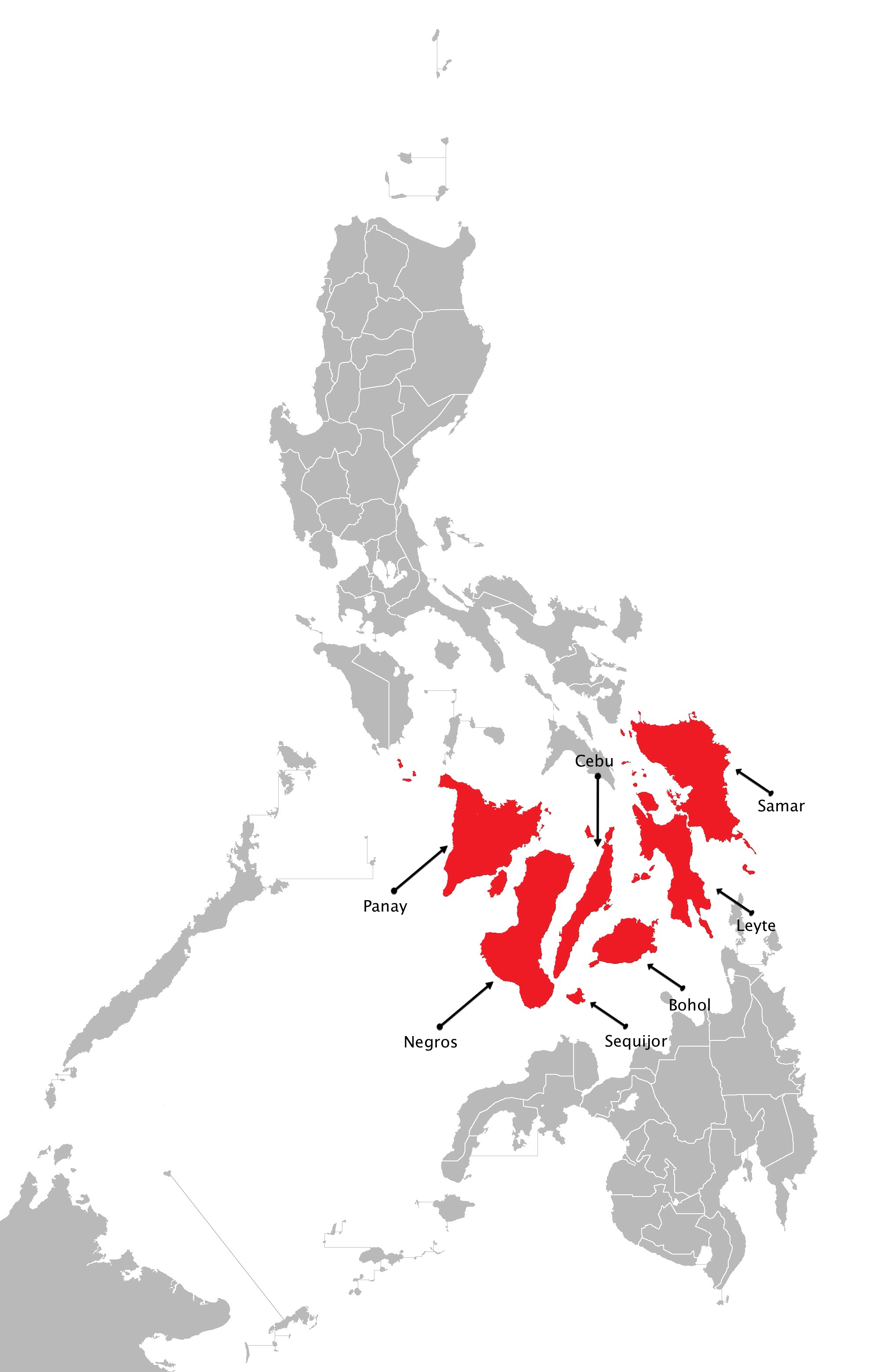
The Visayas, the Philippines
Eventually we plumped for Negros, persuaded by the Lonely Planet’s introduction of, “if one island has it all”. With diving, hiking up the regions tallest peak, caving, snorkelling, beautiful, remote beaches, and, most appealing, a capitol (Dumaguete) lacking the usual chaos and hustle of Filipino cities and charmingly nicknamed The City of Gentle People. It looked just the place to stop, settle in, get our bearings and familiarise ourselves a little with Filipino culture.
Unfortunately, reaching Dumaguete also meant extending our already exhausting journey into an epic dash across the region, involving multiple taxis, long-distance buses, trikes and ROROs with increasingly exhausted kids in tow and without any guarantee of a bed at the end of our journey.
From start to finish, getting here took seventeen hours. It was sometimes fraught, occasionally baffling and not knowing if we would arrive too late to find a room or if we’d even get to somewhere with accommodation by the time we ran out of transport links added a constant anxiety. But everyone we met was friendly and helpful, and considering that we started the day unfamiliar with the Philippines, we got to see a broad range of places through various windows (and hanging off trikes) that have helped us get a sense of where we are.
And we made it.
Our first choice of hotel had rooms, is clean, comfortable and friendly, and positioned right on the promenade. As I came out to Janet where she waited by our overloaded trike still stuffed with bags and sleepy children and gave her the thumbs up, we all cheered, checked in at lightning speed, threw ourselves into bed with a real sense of exhausted a
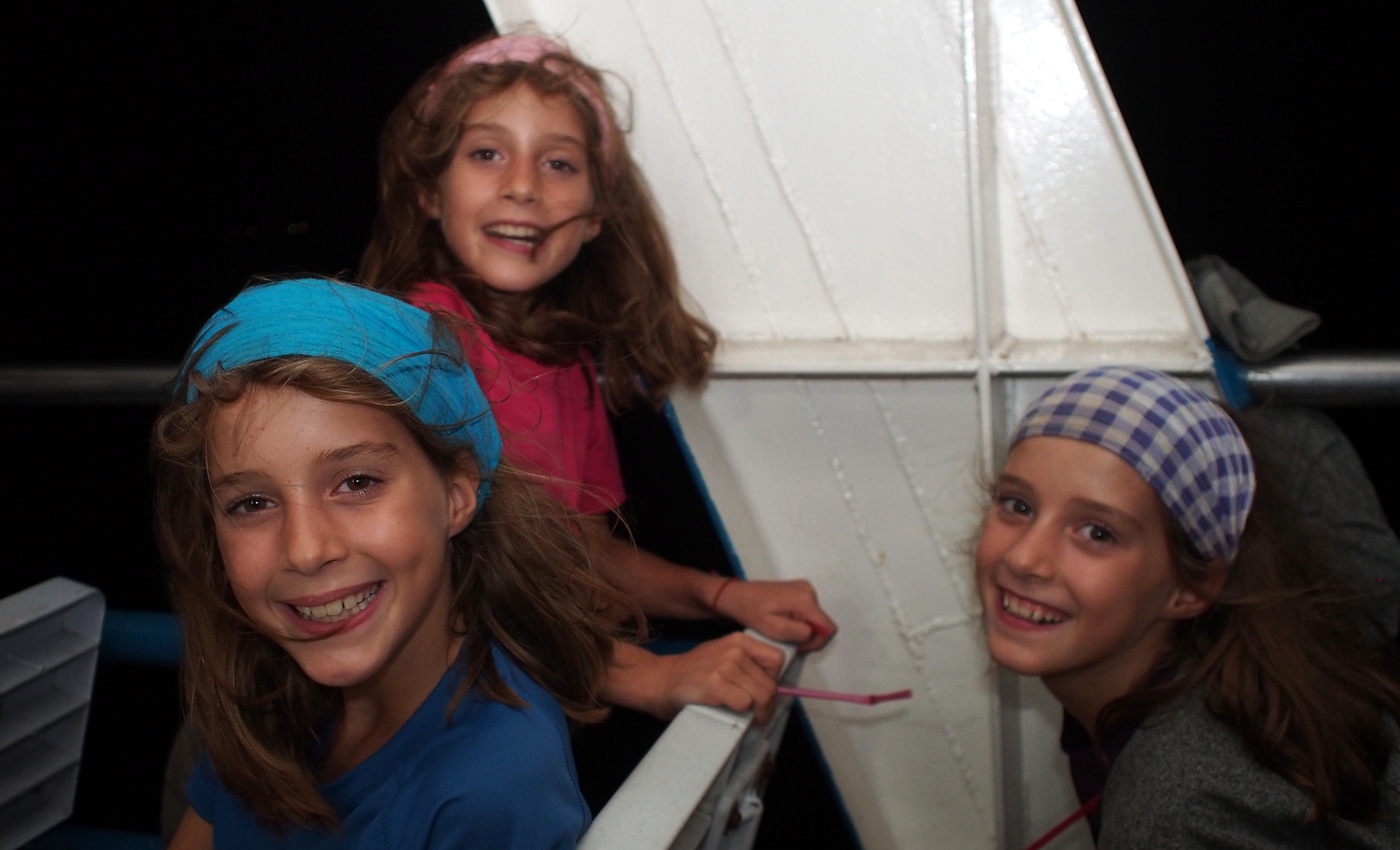
It’s gone dark but we’re still on the road (or the ferry in this case – from Cebu to Negros)
ccomplishment and had fallen asleep within moments.
Much of the thrill of travelling is to launch yourself into the unknown but to come through, tired but invigorated from having experienced the unexpected. It was exhilarating, winging our way here and I feel like we’re really travelling again after the comfortable modernity of Singapore, all the prebooking we had to do in Thailand and Malaysia and staying still for so long in Nepal.
But I think we’ll stay still for a day or two now.>
NB I wrote this post last week, in Singapore but was too busy shopping to finish writing it. Hopefully posting it from here in the Philippines isn’t too confusing…
Each country we’ve moved on to in our travels has been more modern, more developed, more reliable, richer, cleaner and safer than the last.
In the mountains of Nepal we were walking through regions where everything not made from wood or yaks had to be carried in on the backs of porters, and even in Kathmandu, all roads were single lane and buying anything above necessities was often a laborious task taking up much of the day, if they were available at all.
Arriving in Thailand seemed like being transported into the future – landing in Bangkok was like being swept into a sci-fi film, with its fast cars, neon signs and slick crowds… until we reached Malaysia, where everything again grew bigger and less ramshackle.
But now we have reached Singapore, and suddenly even Malaysia seems ramshackle.
We came travelling in part to escape our safe, predictable, comfortable Western lives. We wanted adventure. We wanted to experience life as the other half of the World’s population live it. And we have. But as well as being stimulating, travelling is also tiring. So arriving in what is essentially a modern Western city after six months on the road is rather a relief.
It’s a chance go shopping without endless haggling, take taxis without arguing over fares, to travel by easy-to-understand, punctual public transport, to enjoy people speaking perfect English, to drink the water and trust the food, to have your privacy respected by strangers, to trust the police. Not that there aren’t downsides: it’s expensive, commercial and scarily strict. But we’re only here for a week. Hopefully we can behave ourselves.
And the city itself is amazing. The skyline is a mosaic of skyscrapers, the monorail is clean and fast, the streets are clean, the people healthy-looking and well-groomed. Like Central London with the grubby bits erased.
So, for a brief few days before we fly out to the Philippines, we’re recharging our batteries and depleting our savings. We’re visiting sights (the zoo, Universal Studios, the ArtScience museum, the famous Raffles Hotel), gawping at the architecture, eating Western food, spending hours in the seemingly endless shopping malls refreshing our well-worn wardrobes, collecting a parcel in the only poste restante we trust in the region, buying gadgets… I’m even going to a game shop for an evening to indulge my hobby of wargaming.
I reckon I’ll be ready to leave here before long, but until then, we’re all enjoying the relief that is Singapore – a home from home while our money lasts.
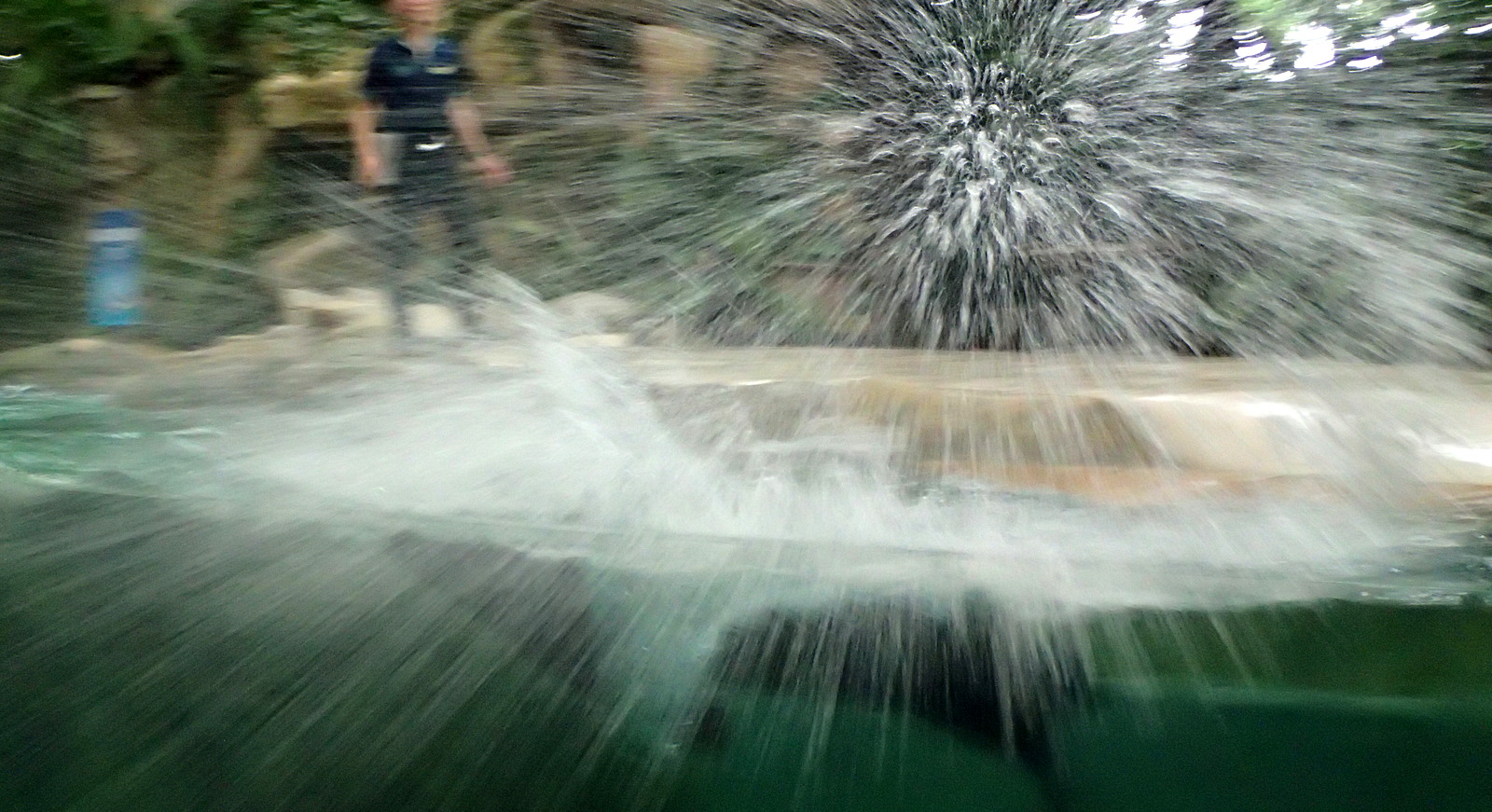
Being splashed by a sea lion at Singapore Zoo
By Scarlett
Things I have been splashed by whilst travelling:
Waves
My sisters
Waterfalls
Ponds
Puddles
Monsoon rain
Cars
Motorbikes
Bikes
Elephant’s trunks
Elephant’s feet
All of the elephant lying down
A sea lion
 Travels with Triplets