Back to the Hotel Malaysia

The Infamous Lift Buttons

In 1982, I was hauled up before the manager of Bangkok’s Hotel Malaysia. He was a stern, disapproving Thai man in a smart double-breasted suit who scowled thunder at me as he sent a bellboy to summon my mother. When she arrived, he explained that I was  banned from using the lifts.

Personally, I thought this was terribly unfair. Me and my best friend, Adam, had only been having fun; going up, and down, and up, and down, stopping at every floor, setting the lift off and nipping out of the door to see if we could beat it to the next floor, waiting till someone got in then hitting every button. All good, wholesome fun.

But apparently some people wanted to use the lift without stopping at every floor or sharing a confined space with hysterical nine-year olds. Killjoys.

And so, the ban; which I assume remains in place till this day (the manager never mentioned an expiry date).

The Hotel Malaysia – or Malaysia Hotel as it has inventively been renamed in the intervening years – was also where I learnt to swim. And I’ve wanted to come back here to indulge my nostalgia for a long time. And so here we are.

Only this time its my girls splashing around in the pool. But apart from that, little has changed. The corridors look shabbier but unrenovated. The lifts are the same. The pool is just how I remember, although somehow smaller.

And there’s an older, stern-looking manager who sits at the desk in the lobby… next to the lifts. Could it be him? I’ve used them twice now. I don’t think he recognises me if it is.

Now to start pressing all the buttons.

Sticks & Stones

At home we have a largish cupboard under the stairs. At first it had a hoover in, some cleaning products, a few bottles of wine, and various other odds and ends with no particular home. And a box of tidied-away toys. By the time we left it contained toys and pretty much nothing else. Boxes and boxes of plush and moulded plastic, most of it hardly played with. Some had been popular once but were now ignored. Others had been caught when Janet or I  tried to smuggle them out to the car boot under the cover of darkness, becoming firm favourites… for a day or two.

Maybe other kids play with their toys more, I’m not sure. But with the choice of two friends the same age to play with, there’s often no need for toys, and no time to sit quietly and play with them even if they get remembered. However exciting it looked in the shop, no piece of plastic compares to a sister for rampaging around with. And when there is an opportunity to sit quietly, books win out over toys nearly every time. In fact the only toys that got any serious use were the active ones: the trampoline, balls, rackets, light sabers, dressing up clothes… whereas dolls, dolls houses, Barbies, My Little Ponies and the other miscellaneous girly toys were left forgotten in their boxes.

Yet despite knowing this, I was worried that my girls would miss their toys when we travelled. They were only allowed to bring one teddy bear with them, no toys, and one small shared set of pencils, pencil crayons and paper, some felt tip pens each, but nothing else.

Luckily, they haven’t missed their toys at all.

I guess the garden full of sticks we left at home should have been clue enough, but wherever we’ve gone, my girls have found sticks, stones, pieces of discarded string, leaves and flowers to build games around. They all became enormously attached to their trekking sticks. And we’ve spent days skimming stones on the river in Sauraha. Sticks and stones provide more fun than the boxes of toys ever did.

And why shouldn’t they? Everywhere we go the local children are also playing with sticks and stones. Up in the Everest Region, where everything has to be hauled up the valley by a yak or a porter, I never saw a single piece of moulded plastic.

OK, bear with me now. At this point, please imagine for me the sound of screeching tires, the needle scratching off a record, or whatever other sound effect they’d use in a movie to show that the narrative has just come of at a hairpin turn, flown into a chasm and crashed into flames. Because I paused at this point in writing this post for a day or two, wondering how to wrap it up, and at the same time my girls persuaded me to buy them some sweets from a local shop. Some sweets that came with a small, moulded plastic panda. Which they love.

These little pandas have been played with constantly for days. They’ve been to space. They’ve explored. They’ve fought baddies and each other. They’ve been on all manner of adventure and all the while, the sticks lie forgotten. And the stones are left abandoned. These days, the only toys that matter are Panda Policeman, Panda Nurse and Panda Chef, moulded plastic heroes that beat sticks and stones any day.

So much for my knowing sermon on simplicity. I’m off to play on my iPad.

Nepal Through the Eyes of a Grown-Up

Reading back the answers my girls gave in their homeschooling task this morning, I thought I might have a go at it myself. It only seemed fair. – Fergus

Oh, go on then, seeing as everyone else has had a go. – Janet

1. Describe a journey in Nepal including 5 things that are different to England.

Fergus: Wait a minute, didn’t I already write a post all about this. Alright, alright, I’ll do another one. How about walking through Thamel, the tourist district of Kathmandu.

Thamel streets are narrow, uneven and pavementless, flanked by a dizzying repetition of small trekking shops, travel agencies, brassware shops, carved wood shops, ethnic clothes shops, bakeries and restaurants for every national cuisine. Looking up, your vision is filled with placards, billboards and signs for trekking guides, travel agencies, trekking gear shops, restaurants, bakeries, guesthouses…

Every few steps, hawkers offer tiger balm, wooden flutes, strings of beads or approach playing excruciatingly screechy sarangis. “You want? Good price. Where you from, my friend?” And if you dwell for even a second on a window display or stall, the owner comes rushing out. “You like? What you look for? Where you from, my friend?”

And then there’s the traffic; in a land without pavements the car is king, but it’s the motorbikes that’ll get you. Weaving in and out of the pedestrians, cars, carts, wheeled stalls and bicycles, motorbikes come snarling at your heels, beeping for right of way.

Mix into all of this the CD and ethnic goods shops that all play the same Om Mane Padme Hom tune relentlessly on repeat, the dust in the air that has you rasping within hours and the occasional scabrous street dog, and you have journey that is always exhilarating, no matter how short.

Janet: As I’m writing this on the plane, I’ll reflect on the journey this morning to the airport.

Kathmandu awakes to the sound of baying dogs, tea-vendors and the unceasing honking of horns. We leave the hotel before dawn, bleary eyed but ready for the adventure of a new country.

As I leave this strange and wonderful land behind, I notice with an affectionate fondness the myriad of tiny shops, the haphazard layout of the streets and the stunning backdrop of 360 degree mountain ranges.

I am no longer afraid of the seemingly endless series of what we would call ‘near misses’ on the roads in England. The swerving of the taxi past the rickshaws, mangy dogs and motorbikes feels calm at this early hour compared to many of the journeys we’ve made.

It’s a little out of town to the airport, which means we go past some of the more humble residencies of this city. After 3 months, it still never ceases to make me draw in breath sharply and clench my stomach to see some of the places people call home. I vow never again to complain about the children sharing a room as I see the families crowded into shacks with no fronts, huddled around a fire made of rubbish to keep away the morning chills.

We arrive to the usual barrage of offers of help to carry bags (for a few rupees, why not?) and polite enquiries of, “Three daughters? All same same?” which has recently almost been usurped by, “What happen?” in reference to Scarlett’s broken leg.

I’m struck by the contrast between the many and varied international airports I’ve travelled through compared with this one. It’s the little things. Like the fact that the entire row of seats tips forwards as Scarlett sits down – they’re not screwed to the floor. And the fact that we spot 4 birds and 1 cat on our way to the departure gate. Indoors. That’s not normal.

We’ve overstayed our Visas due to Scarlett’s accident, only by a day, but we expect to pay a $66 USD fine. However, with a muttering of, “Today, 17th”, and a characteristic wobble of the head, we are waved through passport control with no fine to pay. So we have a relatively large sum of money in a currency you can’t change outside of Nepal, no bank, and the limited airport shops. The choice is between some T Shirts that don’t fit any of us, some chocolate, a fridge magnet or a coffee. We settle on a drink each and a T-shirt for Evie (she’s one down) and give the rest to a children’s charity.

It’s a lovely way to spend our last morning. Nothing is quite ‘normal’ but that’s kind of what makes it fun, and it’s definitely what makes it Nepal.

2. Finish this sentence: In Nepal, I have learned…

Fergus: …to slow down.

The internet in Nepal is so slow it is often unusable, so I quickly had to break my web habit. Facebook loses it’s shine when it takes 40 minutes to load. Travel takes ages. Food comes slowly in cafés. Bureaucracy requires more chitties, desks and members of staff than I ever though possible. In fact, any kind of organizational task needs a whole day setting aside to perform.

But if you slow down, it’s fine. When in Nepal, go as fast as the Nepalese go.

Janet: …to be polite. Now being British, we pride ourselves on being polite. I like politeness, and I like people to treat me with courtesy and respect. But even the famed reserve of the English cannot compare to the Nepali culture. The way that everybody in this land conducts themselves is both alien and admirable to me. I realise, slowly, over the months that we spend here, the difference between what I think is polite and what is actually polite here. For example, it’s fine to ask personal questions about your family, your job, even your income. But it’s not OK to raise your voice, to be impatient or, worst of all, to loose your temper.

It’s sometimes a subtle touch of the arm as you hand over money, a nod of the head to acknowledge thanks, and of course the head wobble, but if you can get into the local body language you find people respond with a smile and with a polite interest in getting to know you better. I’m glad we stayed long enough to get a real feel for this part of the Nepali culture.

3. Finish this sentence: In Nepal, I have enjoyed…

Fergus: …spending every day with my family.

Trekking together was wonderful. It gave us the time to talk and to listen. And there’s something about walking that makes thinking somehow clearer. But even in the cities or Sauraha, we’ve had time to really enjoy being in our little family unit. No school or work to separate us. No demands from laundry, shopping, housekeeping or garden to drain our free time. Just us, every day; talking, learning, laughing, playing games, eating, exploring.

Janet: …the mountains. I simply love being in mountains. Since the age of about 13 when I went of my first walking holiday with a group of girlfriends from school I’ve been totally hooked on mountain walking. My greatest achievements in mountaineering don’t amount to much: I’ve done the coast to coast walk (solo!) and the Yorkshire and National 3 Peaks, but nothing on earth can compare to your first view of the Himalayan Massif.

There are no adjectives adequate for the spectacle. I won’t do it the injustice of trying to describe it in words. But for me, this is what I came to Nepal for, and stepping onto the summit of Gokyo Ri and turning around to admire the view on all sides will always be my personal highlight.

4. Finish this sentence: In Nepal, I have endured…

Fergus: …the unexpected.

Of course, Scarlett’s accident was the biggest unexpected event, and I realize now that it threw us all into shock. But there have been other changes of plan, too. Not going to India. Not going to Sri Lanka. Rejigging our time in Thailand to hit most of the beaches after Scarlett’s cast is finally removed in February. Plus, just going to new places means one never truly knows what arrival will bring with it.

Having the future so much in flux can be unsettling but it’s good to be shaken out of my routine. Not knowing what might happen tomorrow brings today into focus and makes me notice the passage of time in a way that I never do back home.

In fact, being thrown into unexpected situations reason – good and bad – is much of what makes travelling so rewarding. In responding to a challenge, you find out who you are and what you’re capable of; you grow.

And doing the same thing you did yesterday never made for much of an anecdote.

Janet: …bureaucracy! OK, so obviously the worst thing that happened was Scarlett breaking her leg, and the resulting shock that I was thrown into. But if you wanted to make a bad situation worse, you couldn’t have done it better than adding in a dose of Nepali bureaucracy to the equation. As a previous post describes, it’s one thing I’ll be glad to leave behind. Not that I’m expecting SE Asia to be much better, I’m just hoping not to have to do anything so ambitious that involves any level of paperwork!

5. Describe a Nepali person you have met. Include what they look like, their personality and your opinion of them.

Fergus: I’m going to go for Phurba Sherpa, too. We were walking with him day in, day out for nearly a month, and got to know him better than anyone else we’ve met.

He had the physique common to many Sherpa people; broad shoulders, thickly-muscled calves, the body of a man who has carried massive loads into the clouds, year after year. He was always calm and polite. He seldom smiled, although the kids would make him laugh sometimes, especially in their wilder moments.

Quiet, understated, assiduous and reliable, he was always working to smooth our relations with locals, to help us order food or find the best place to stop, and was always on hand when needed from dawn till dusk.

He was a family man and, I guess because he was away from his own kids, he became very protective and kind to our own, several times carrying one girl or another when they ran out of steam and often buying sweets or snacks for them as we walked.

Turning up in the Everest Region completely without a guide was a gamble, but it paid off in meeting Phurba.

Janet: One of the silver linings of Scarlett’s accident is getting to know some of the people in Sauraha, near Chitwan National Park. Having returned there to rest and recuperate, some people welcomed us back like old friends, most notably a shop owner who was always very taken with the girls. Being triplets, they attract a lot of attention, and he sold them 3 lovely dresses which he was very proud of as they walked down the main road in them on an almost daily basis.

When he saw Scarlett’s leg in a cast, he was genuinely heartbroken, he took my hand in both his and vowed that if there was anything, anything at all he could do to help us, he would help. He said he has a car, and could drive us to hospital any time of day or night if we needed it. It was very touching.

The help we ended up taking was his offer of teaching Scarlett the Nepali ‘Tiger Moving Game’. As Evie and Jemima headed off to elephant bath time each day, Scarlett and I would make our way down the road to his shop, where we’d play a couple of rounds of this local chess-like game. It helped us to get a change of scene, it gave Scarlett something to look forward to, and made her feel special when she would otherwise have felt left out.

He was a middle aged man, a little larger than the typical Nepali build, with the smart dress sense of a man who has made it into the middle classes of Nepali society. Softly spoken, but outgoing and friendly to everyone, he chatted to us about his early morning badminton matches, the births and deaths within the local community, and the trouble of keeping the dust and bugs out of the shop.

I’ll miss the slow pace of these daily conversations and the feeling of belonging to a tiny part of the community that this friendship gave me and Scarlett during our unexpectedly long stay in this small part of the world.

6. Make 3 recommendations for an English person who is planning to visit Nepal.

Fergus:

  • Learn to love lentils. Seriously. You could never call the Nepali diet adventurous. In fact, most Nepalis eat the same meal every single day: daal bhat (which literally means dahl and rice but is normally served with some or all of wilted spinach, mild vegetable curry, yoghurt, bitter pickles and popadom). You don’t visit Nepal for the food.
  • Get fit. Walking up mountains is a lot easier if you’ve, well, walked up some mountains before. Even English ones (which our guide thought hilarious we called mountains at all).
  • Don’t get carried away buying trekking gear. Like most foreigners we were kitted out in expensive boots, base layers, thermal layers, fleeces, goretex jackets, walking trousers, walking socks, buffs and hats… while many sherpas wore jeans and even flip-flops, with a carrier bag containing trainers and a jacket for when they got higher. Not that I’d go that far, but really, only good boots, walking socks and a warm jacket are really essential. And anything you don’t have, you can buy much cheaper in Nepal once you decide that you need it.

Janet:

  • Trek! You can’t go to Nepal and not see the mountains. Train for it, prepare for it, buy the right equipment for it (possibly in Thamel at a fraction of English prices) and enjoy it. You won’t regret it.
  • Lower Your Expectations when it comes to accommodation. You need to learn to be delighted by hot water, rather than disappointed by lack of it. Only then can you truly appreciate your surroundings.
  • Look Out for those cliff edges. You could break a leg.

7. Finish this sentence: The thing I will most remember about Nepal is…

Fergus: …mountains. No, elephants. No, mountains. Can I have both?

I fell in love with the mountains when we were trekking, and came to love being close up to elephants in the lowlands. In both cases, as I spent more time in their company I came to see their idiosyncrasies. They no longer looked the same (as one another, I mean – I can tell a mountain from an elephant), and I could see what made each interesting, impressive or beautiful.

Janet: …the helicopter ride out of the Annapurna region. The ultimate day of highs and lows. The shock of Scarlett falling. The realisation that it wasn’t just a sprain. The waiting for the insurance to call back. The relief that they would pay for her to be flown out. The crowd of people taking photos as the helicopter landed for us. The way their hair blew back as we sat in the cockpit and waved. Their friendly gestures in many languages, pointing at legs and thumbs up signs, conveying their get-well-soon messages. The stomach flipping take off. The breathtaking panorama of mountains surrounding us. The gnawing anxiety over what Scarett’s X ray would show. The growing guilt that it was my idea to come here, to put her in this danger. The relief that the hospital was well equipped. The surprise that it was in Kathmandu. The dawning of the idea that this could be the end of the trip. The trouble of sleeping on the sofa-bed that first night. The wondering what would happen to a local girl, aged 8, with no such medical care, if the same thing happened to her. Ultimately, the gratitude in realising that we are very, very lucky. Very lucky indeed. These are things that I will remember for ever.

On the Road Again

Is it really three weeks? Tomorrow we get on a bus to travel 7 hours over potholed roads edged with precipitous drops and soaring cliff faces to Kathmandu, then after 24 hours rest and a last chance to eat cheese before hitting SE Asia, we fly first to Delhi then Bangkok, where,  after another brief 24 hour rest, we jump on a sleeper train,then a ferry, then a songtiaw to Maenam on the island of Ko Samui. That’s five days of travelling.

But I am really looking forward to it. We’ve been very sedentary here in Sauraha but Scarlett had a checkup with her orthopaedic surgeon this week and he’s happy for her to start moving around more now. So we’re hitting the beach!

The Hospital

By Evie

Unloading Scarlett from the Helicopter

After an unexpected, bumpy helicopter ride we arrived in hospital and waited. What was wrong?

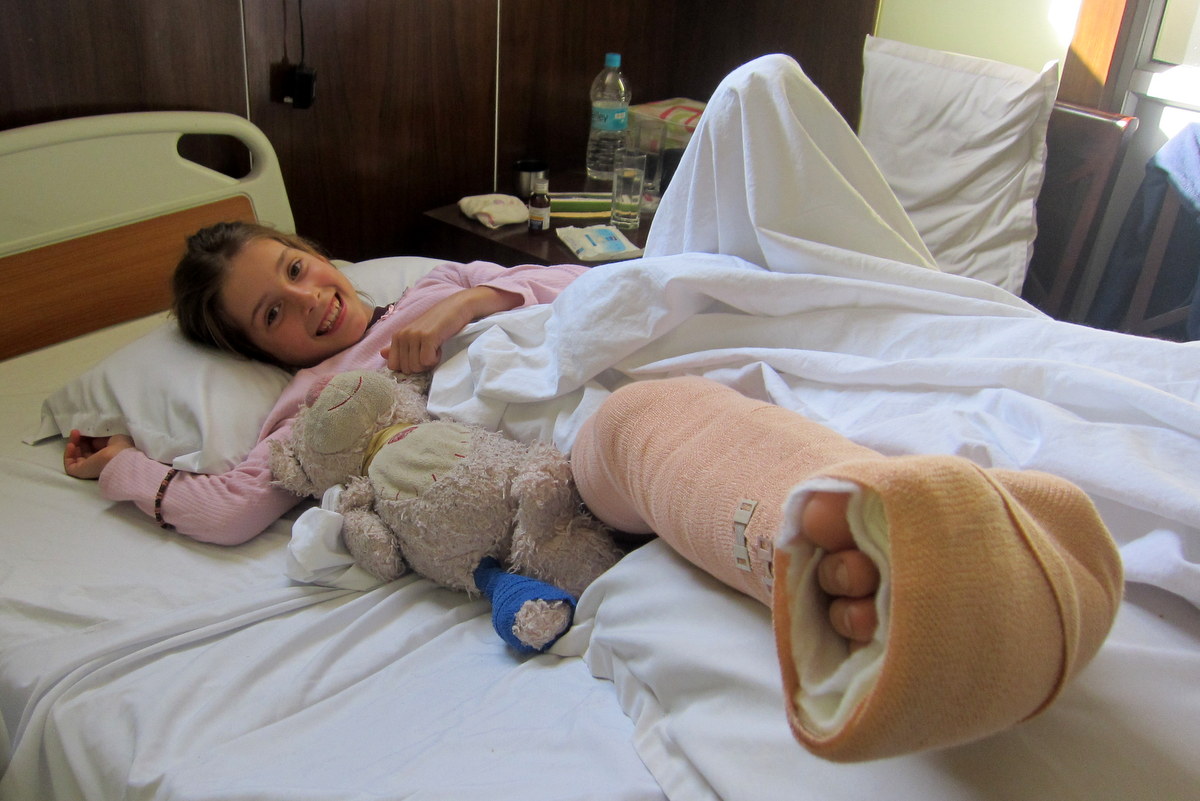
When we arrived, Tettie was taken to a private room in the hospital called the Emergency Department. Only Mummy and the nurses were allowed in. Next moment, a Tettie on a stretcher came past! Amazing news ­– her leg was broken!

Soon after, we were in the room, the room Tettie lay in for 8 days. The room was comfortable, had enough beds and ,most importantly of all, there was space for me and Mima to play. Of course, we didn’t like Kathmandu particularly, however we couldn’t help liking our cozy room.

Tettie got a moving bed. I was so jealous!

Scarlett in Her Hospital bed

We went to the zoo twice. We saw 2 tigers and a leopard and lots of deer and 8 bears and 4 monkeys and 5 buffaloes and lots of fish (including piranhas) and even a few guinea pigs!

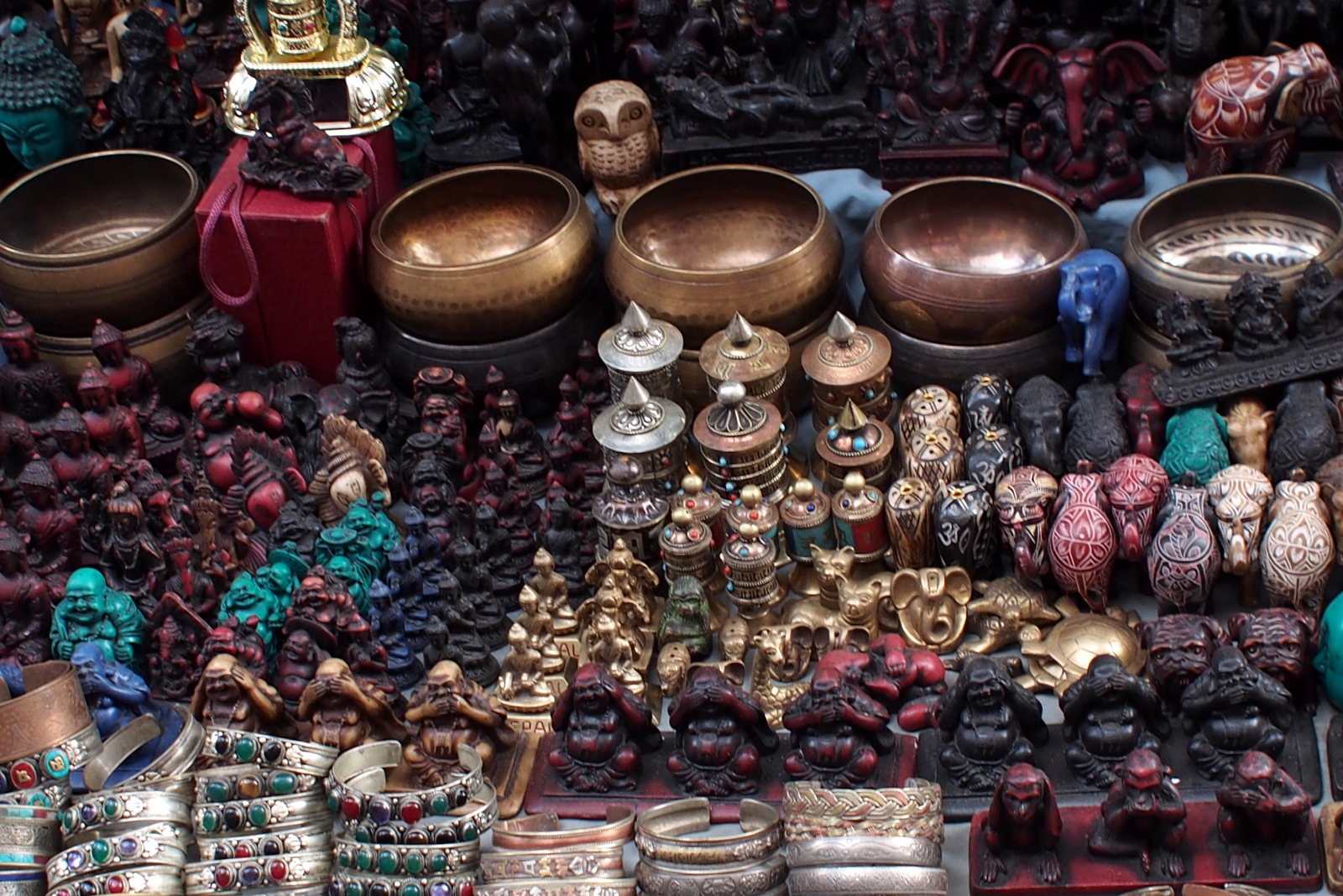
Another day we went shopping for animal carvings in Thamel and Mima got a tiny gold tiger. Later, however, she  said she wanted a golden deer that she had wanted for ages (more than 2 weeks!) I found a pegasus which was too much money (2000 rupees). A really sad day for me. Daddy says I can get it if I still want it after our 3 week trip to Chitwan though.

Thamel Souvenir Stall

Spending a week in hospital was a bit much although the food was tasty and the beds were comfortable. I was sorry for Tettie because she couldn’t do these many things, just lie and wait. I guess she enjoyed night more than day! Poor young Tettie Wettie Woo Woo, falling from so high.

A Heroic Helicopter Ride

By Jemima

A helicopter came down to meet us as we waited with a girl who couldn’t walk at all!

Waiting for Helicopter Evacuation

It looked like it was snowing as bits and bobs of wood shavings flew up in the air and came down again with the force of the helicopter. Tettie was almost blown off her chair and Evie was pushed into Daddy by the force. We were all loaded into the helicopter…

I sat in the back next to Tettie and Evie. Evie sat next to me and Mummy. Tettie sat next to the other window and me. Mummy sat next to the other window and Evie. Daddy sat next to the pilot and the other window. And the pilot sat next to Daddy and the other (last) window.

Scarlett Onboard the Helicopter

The pilot was very good at steering. We set off for Pokhara, or so we thought.

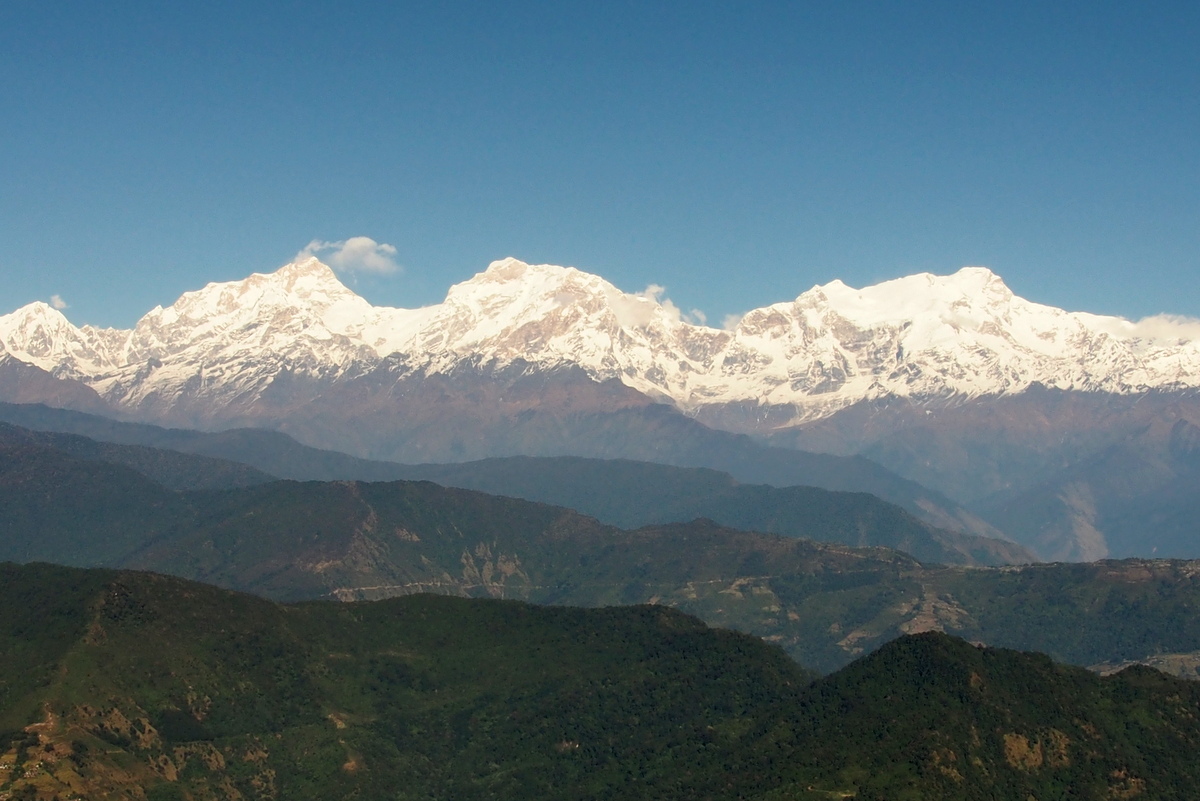
As we flew we saw sky all around but mountains all below. We took many photos of the mountains. Basically, we flew over the top of nit noy (the Thai word for tiny) Nepal. Mountains plodded past us as we moved slowly along. There were lots of mountains with snow on. The snow was brilliant and beautiful and impressive! Great steps of field rose up and up and disappeared over the mountains. Little toylike houses moved past so slowly it looked like the helicopter was staying still and they were being pushed but they were so heavy the process was slow. Big, fluffy clouds pressed on either side but we never passed right next to or through one.

This slideshow requires JavaScript.

It was the first helicopter ride we had ever had and it was really exciting. Me and Daddy and Evie might not have got to go on the helicopter but we did. If the helicopter had not come at all then we would have had to carry Tettie to the road where we would go to Pokhara in a car.

When we arrived in Pokhara, we landed on the roof of the hospital and realized we were in…

Kathmandu!

How a Pizza Broke My Leg

by Scarlett

I never realized what would happen when I ate that pizza…

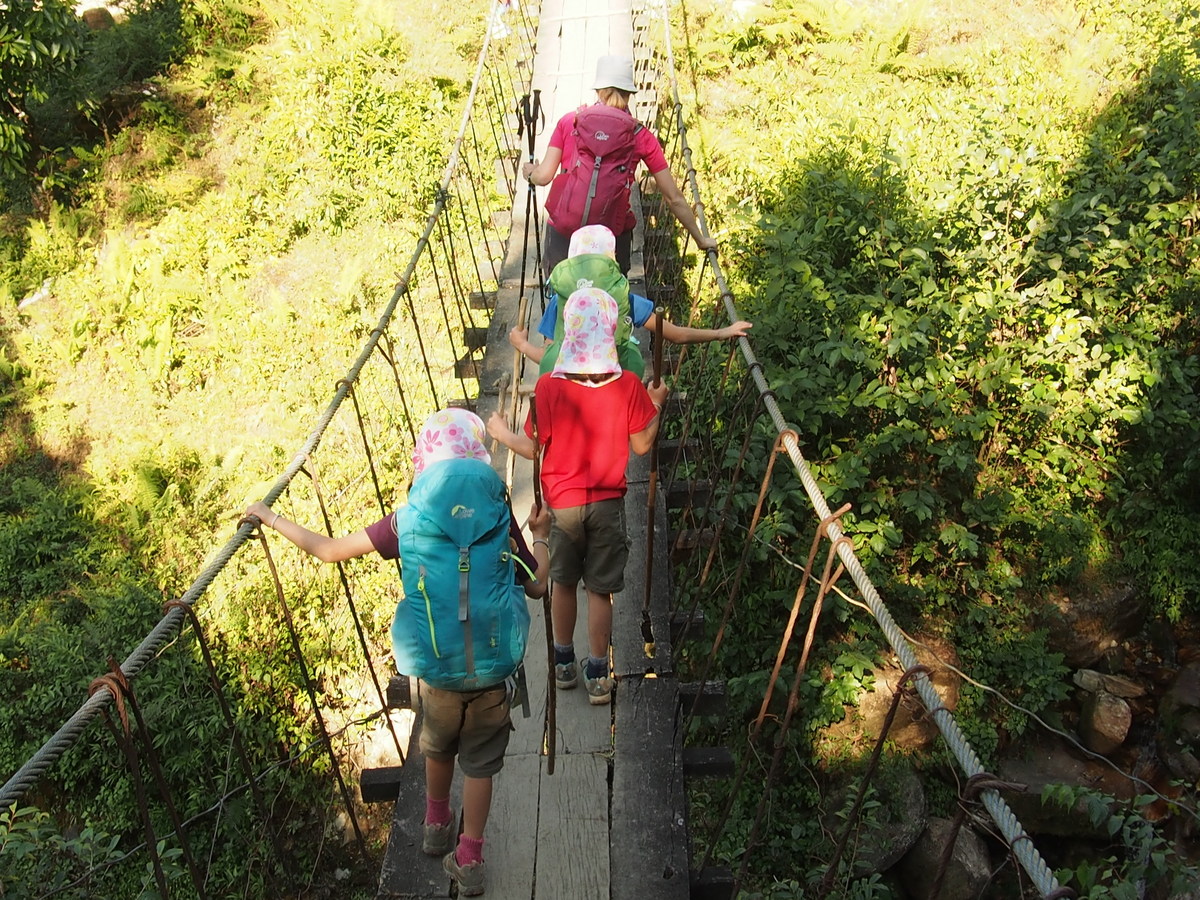
Suspension Bridge on Annapurna Base Camp Trek

First we went down and flat. But that was only the first part of the day’s trek. Then we crossed a suspension bridge and went up. We were climbing steps forever or so it seemed. Sometimes the steps were little, sometimes the steps were big. Sometimes the steps were smooth, sometimes the steps were bumpy. Sometimes the steps were thin, sometimes the steps were fat. But always the steps went up!

When at last the steps came to a halt at the top of the hill, we had veggie curry and rice each (normally we get three and share). After lunch we climbed again the neverending steps up to our destination, Chommrong!

We were very hungry from all this walking and had three pizzas for tea instead of the usual dhal bhat. Of course, we shared and laughed together, playing pontoon, writing diaries and Mummy and Daddy reading Harry Potter to us. It was most comfortable in that little dining room with civilization all around us.

Then the pizza came and it was delicious. The rich taste stayed in your tummy for a long time after you ate it. Then we climbed yet more steps to bed feeling satisfied, unlocked the door feeling satisfied and got into bed feeling satisfied.

In the night I woke up feeling sick. I got up or tried to. Because as soon as my feet left the bed they hit the wall! I’d tried to get out of the wrong side of my bed. When I was at last out of bed, I felt my way to the wall. It was pitch black! Then I started to cry in despair because I didn’t know which way to go. Luckily, Daddy heard me cry out and showed me the way and I went to the toilet and back to bed.

Then I told him I didn’t feel well. He brought me something to be sick in. Almost immediately after he had left, I was sick! This time Mummy came and sorted me out.

When I woke up again, I was informed that we were not trekking again that day because I was ill but we were exploring the village.

On our way, I fell four or five metres! I landed on my leg it really hurt and the pain didn’t go away. Everyone was asking if I was OK. I said no.

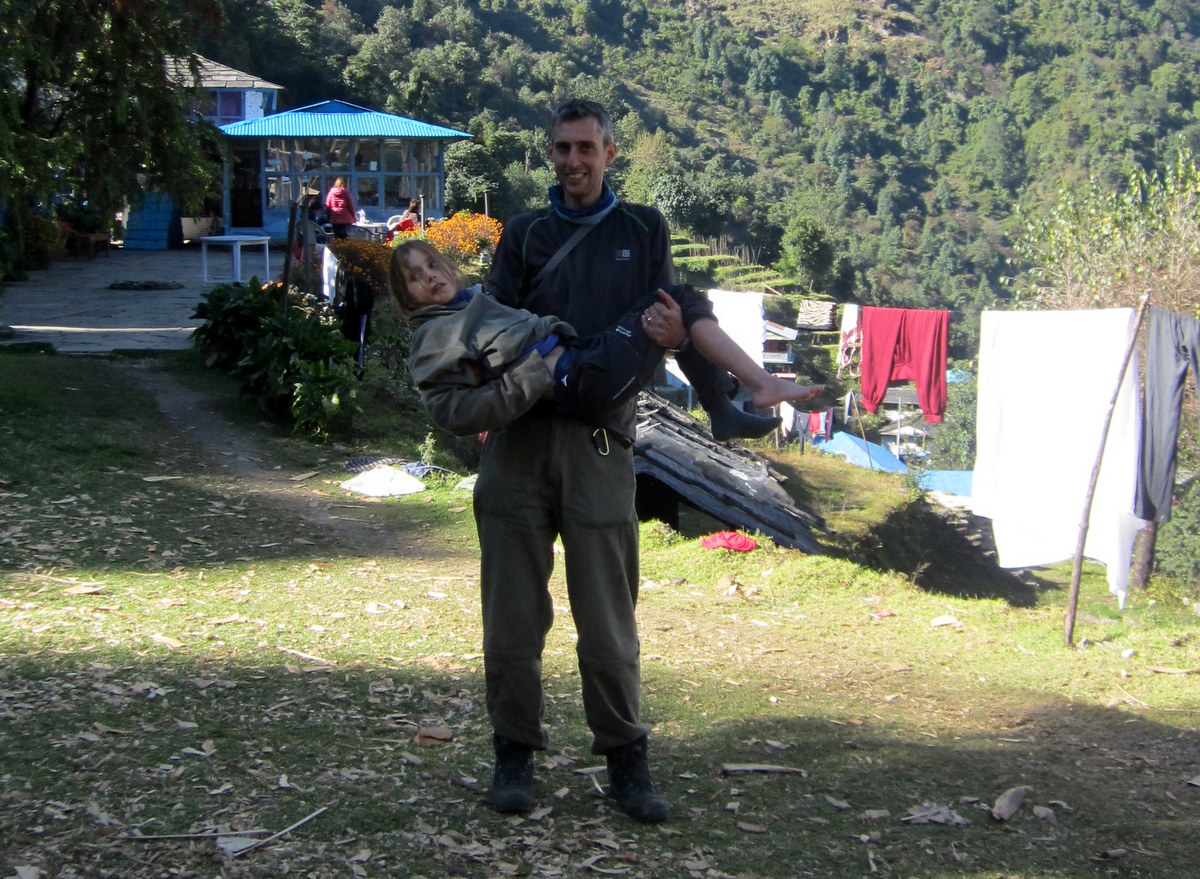
Then Daddy carried me back up the hill to our lodge so that his arms ached.  Every time he stepped, it hurt my leg. When we reached the lodge, I lay down and Daddy ready Harry Potter which I definitely think made it better.

Carrying Scarlett to the Helicopter Landing Field

Then a helicopter came and took us to hospital. The flight was amazing! I felt as though I was floating on a very noisy cloud! The view went on all the time we were on the helicopter. Mountains skidded past and beneath us us villages skated. Forests seemed like patches of grass and I couldn’t see the difference between paths and rivers.

Himalaya Range from a Helicopter

Then we landed on the roof of the hospital and found out we where in Katmandu instead of where we thought we were going, Pokhara.

I never realized what would happen when I ate that pizza… I would end up in Kathmandu with a broken leg… But now I do!

Street Life

As much as I’ve come to dislike the noise, hassle and creeping throat infections endemic to Kathmandu, I always like the taxi journeys here.

Maybe it’s because of our first taxi ride from the airport, when I was fresh with excitement for our trip and flooded with the sheer relief at no longer being on a long haul flight, but just looking out of the window is endlessly entertaining. Scene after scene flashes by, almost too briefly to take in. Even as my mind tries to process what I’ve seen, I’m confronted with something new to surprise me. And it’s all made even more exhilarating by the constant shriek of car horns and the fact that right of way seems to go to whichever driver has the most guts and whichever vehicle has the most inertia.

A few of the vignettes I glimpsed on our last break-neck journey through Kathmandu:

A forlorn-looking man sits at a metal table, a single joint of meat and a cleaver upon it. Will he sell it before it goes bad?

A grubby girl in torn clothes crouches on the curb. On a blanket before her she has arranged beautiful piles of chillis and garlic.

A man welding in flip-flops. Sparks scatter over passing traffic.

Two small children wearing fluffy pyjamas, no more than three years old, walk along hand-in-hand beside the traffic.

A crowd clamours around a tea stall. The stall next door remains ignored.

A man disassembling a motor on the pavement.

A sign for an English Boarding School with the word academy misspelled.

Confectionary-coloured buildings: pink, turquoise, lime green, yellow.

Cows crowding at an intersection cause three main roads to slow to a crawl as drivers inch past them.

A woman with five children clustered around her legs makes a dash across the traffic to a chorus of beeping horns and screeching brakes.

An open door reveals a room no larger than our kitchen back home, filled almost entirely with one bed for the whole family.

A woman washes at a public pump, deftly juggling wet hair, toiletries and a sarong to conceal her modesty.

A row of lorries, more ornately painted than a gypsy caravans.

Little shops everywhere. In doorways. On railings. On pavements. Stalls, carts, trays round necks. The air of desperation and poverty increases as the size of premises diminishes.

Dogs everywhere; sleeping, loping, sunbathing, begging, stopping traffic. Some look relatively healthy. More are scabrous or mangy. One has an open wound on its head, what looks like brain showing through.

A gang of laughing teenagers playing on their phones. All the boys are holding hands.

Chickens scratch at the rubble of a collapsed building.

Kathmandu, We’ll Soon Be Seeing You

We’re free! It’s 6am and were all loaded onto the bus waiting to set off back to Sauraha, next to Chitwan National Park.

It was late yesterday by the time Scarlett was discharged from hospital, then, this being Nepal, there was a last minute problem with the internet so we couldn’t get all the paperwork we needed. We were promised it would be sent on but we’ve learned in the last few months that these things are much better sorted out on the spot, so we waited around in our room for an extra few hours.

Eventually we left. But with all out bags and bodies, and Scarlett in her plaster cast and with crutches, there was no way we were going to fit in one vehicle. The hospital had arranged an ambulance for Scarlett which we crammed with as many bags as possible (plus Scarlett and Janet, of course).

The ambulance screeched off into the mental Kathmandu rush hour traffic, sirens blaring. Me, Evie and Jem watched it weave across a packed intersection then tramped off to find a taxi. I was worried that Janet would be stranded with both Scarlett and a mountain of baggage but luckily our taxi driver was equal to the mentalness of the traffic, and without even the aid of a siren, managed to arrive across town mere moments after the ambulance.

We’d splurged on a more expensive hotel for the night – the original Kathmandu Guest House where The Beatles and Jimi Hendrix once stayed – because unlike all the other Thamel guest houses, it has both a garden and restaurant on the ground floor. Not something I’d normally pay $45 a day for but I really didn’t want Scarlett to brave the hectic, pavementless streets of Thamel yet nor did I dare carry her around. Even with able-bodied children, the streets of Thamel take all my concentration to navigate.

We didn’t have tickets to leave Kathmandu yet, and there was loads of organising that needed to be done to clear things with the insurance company and see if we can fly out of Nepal with Scarlett in a full-leg cast, so Janet went off to a cybercafe while I stayed with our girls in the garden.

It as fine at first. Evie and Jem went off exploring, occasionally popping out of flowerbeds or dashing across the lawn, while Scarlett and I did slow circuits of the paths to help her practice with her crutches.

Then Scarlett announced that she needed a wee. And, of course, she was bursting. It was coming. Now.

I immediately began to consider the logistics. Two children off hiding in the undergrowth. One too slow on crutches to reach the toilet in time. No idea where the toilet was.

Letting her crutches fall, I picked up Scarlett, tramped around the lawn calling for her sisters and, having finally found them behind some flowerpots, got Jemima to retrieve the crutches and set off inside. Evie had been to the toilet with Janet earlier, so I asked her to lead the way. So far, so good.

Except, after five minutes wandering through the surprisingly extensive hotel, I began to suspect that Evie was lost. Our next turn took us back into the garden. Yes, she was lost. And my arms were burning from Scarlett’s weight.

Abandoning the search for a downstairs toilet, we made a dash our room. Negotiating the stairs in flip flops while carrying a child who was becoming heavier by the second was made no easier by Jemima leading the way on crutches and a constant barrage of requests from Evie to use the iPad while Tettie was on the loo but eventually we reached our bedroom door.

Wrestling the crutches back from Jemima, I put Scarlett down, found the key and opened the door. I hovered behind her as she hopped inside, managing to keep her balance despite her sisters barging past. I turned to close the door, and CRASH!

She’d fallen. While I was turned, she’d set off again and her crutch had slipped on a rucksack strap. She was crying, gasping in pain, whimpering, “My fractures, my fractures!”

It was all I could do not to burst into tears myself. For first time since we set off in September, I just wanted to be at home, with Scarlett comfortably on the sofa , the other two in the garden, bouncing happily on the trampoline and everything we needed to be safe and secure.

I think Scarlett must have picked up on my upset. After I’d carefully laid her on the bed she started being very brave, telling me earnestly, “I’ll be ok in a minute daddy. Don’t worry.” If anything, I now felt worse.

After half an hour or so and with Scarlett restored by the combined soothing powers of cuddles, ibuprofen, paracetamol and Harry Potter, I was able to carry her carefully down to the guesthouse’s restaurant where, once again, having a garden paid off. I sat with Scarlett while her sisters had somewhere to play (does jumping out on guests from bushes and singing “namaste” count as playing?).

Eventually Janet returned and, with two adults, everything became manageable once more. Plus she’d managed to get tickets out of Kathmandu for the next morning. We were headed back to lovely Sauraha – the only place in Nepal we could imagine holing up for any time with an injured child.

I think Sauraha will be much easier. Scarlett can sit still not he veranda, the lawn or in one of the nice shady huts; I could even string up my hammock. Her sisters can play. There are fewer distractions, fewer dangers, fewer stairs. We know our way around. Of course the fact that Scarlett was able-bodied last time we were here may prove frustrating for her, but we also did a lot of schoolwork there, which she’ll be able to join in with despite her immobility.

Until we return to Kathmandu in three weeks anyway…