Sugar Beach (Far Away in Time)

This slideshow requires JavaScript.

Tomorrow, we move on again. But for a change, it’s after a (for us) long pause in one place. We’ve been here at Sugar Beach, near Sipalay, for a whole week, after deciding that our girls would benefit from slowing down for a while.

Whenever we ask them where they’ve like best, all three girls invariably name the places where we’ve stayed the longest – Chitwan, Savannakhet, Ko Tarutao – even though their favourite experiences aren’t necessarily from these place at all. I think they just like these moments of stability where they can get to know somewhere and feel like they’ve got a home from home.

After racing though Malaysia, never stopping more than three nights anywhere and dashing around Singapore for six very packed days, we decided to head to our girls’ top type of location: the beach.

Unlike most beaches in the Philippines, Sugar Beach is good for swimming (others tend to be too corally, too rocky, too tidey or too sea urchiny), it has nice, wide sand and lots of Western-run places to serve up the kind of comfort foods our kids love (spag bol, sandwiches, pizza, bacon and eggs, fried rice, French fries) but at the same time is remote enough to feel off the beaten track and for the resorts to be idiosyncratically-small scale enough for me and Janet not to feel like we’re in a tourist trap.

Each day here has consisted of little more than trying to ensure our kids at least brush hair and teeth before letting them run off to swim, pet the resorts’ dogs, dig in the sand, climb coconut trees and make friends with the staff, then, later, trying to round them up to scrub the salt, dog and sand off them (and patch up coconut tree grazes) in time to eat. They’ve loved it.

The other thing that we’ve noticed makes them happy is routine. Too much idleness and there’s a noticeable increase in bickering and boredom. So staying still was also an opportunity for homeschool. In between running wild, we’ve been corralling our girls and working on more maths or letting them carry on with long-form stories they’ve been writing since Nepal (after 2 draughts, we’re finally onto writing them up).

Towards the end of the week, however, while the kids were now ecstatic, me and Janet had begun to get restless. Particularly Janet, who I sensed had maybe had enough lazing around on the sand when she screamed, “Aaargh! I want to climb a mountain!” over breakfast, There weren’t any mountains. But we did walk over the nearest hill that afternoon to snorkel in a remote, uninhabited bay.

In fact, we got rather lost going up the “mountain’, a wrong turning taking us into a rather smelly section of forest we realized rather too late served as the village toilet. We got to the bay eventually though and had a magical time. The bay was coated in sea grass so felt like flying over a strange, otherworldy moor; a moor dotted with enormous, brown starfish and inhabited by beautiful but highly poisonous banded krait sea snakes, sliding sinuously through the “air”. We swam right up to them, marvelling at their elegance and thrilled by the danger.

I guess travelling as a family requires a lot more compromise than travelling alone or as a couple. Just like normal life with a family does. Janet likes seeing sights best, the girls like getting to know one place and my favourite part is the actual adventure of trying to get around, not knowing how it will turn out. Although, to be fair, we all enjoy all of these things to lesser extents. And, of course, we all enjoy eating our way around the World.

So, while all three girls seem rejuvenated by our time on Sugar Beach, it’s time to move on now. It’s been good for them to get a little R&R. After all, we’ve been on the road for a long time and our next destination is Indonesia, which everyone warns us is exceedingly hard work.

But tomorrow we’re leaving. We’ll be spending the next seven days on another Visayan island: Sequijor. And this time we plan to be much more active. There’s old Spanish colonial buildings to visit, waterfalls, caves, coral reefs, even a mountain (well, a big hill). And the whole place has a spooky reputation as the home to witch doctors.

The Philippines: First Impressions

Perhaps it was coming directly from Singapore but it’s taken a little while to work out what’s different about the Philippines. And what’s familiar.

The people look very much like those in Malaysia but noticeably poorer. Designer fashions and branded trainers have made way here for threadbare t-shirts and flip-flops. And, of course, there’s not a Muslim headscarf in sight. Mostly Christian — a legacy of 16th century Spanish explorers — women here dress in the same kind of warm weather clothes you see in Hindu and Buddhist countries. Janet can finally put aside her long trousers and get back into shorts.

Like Nepal, there’s a home-made look to many of the houses, even concrete ones. And it’s not unusual to see an abandoned, half-built house alongside a beautifully tiled and painted one on one side and a giddily-angled wooden-stilted one the other. But the roads are in much better condition than Nepal. Not completely without bumpy, unsealed stretches but without the spine-jarring potholes that make Nepalese bus travel so arduous.

The food is a strange mix of familiar and unfamiliar, not helped by my finding Tagalog words rather difficult to fix in my memory (Sinigang, longganisa, kaldereta…). But the names aside, one thing is very clear: I wouldn’t want to be a vegetarian here. Everything has meat in it. In fact, meat seems to be something of a national obsession. There are roasted chicken shops on every corner in the city, as well as burger stands and restaurants fronted by a dizzying array of meaty stews and soups. As for flavours, after Thailand and all the Indian food we ate in Malaysia, it seems a little bland, relying on savoury flavours rather than spices, salt, sugar, lime juice or chillies. Still, now my palate has lowered its expectations, it’s really rather delicious… More like European or South American cooking than much of what we’ve had while abroad.

And it’s cheap. Not just compared to Singapore. Compared to anywhere else we’ve been. Dining in one of the nicest restaurants in Dumaguete, each dish only cost around £2. Pastries from a bakery cost 3p each. A 2km taxi ride cost 15p each. I feel surprisingly wealthy.

But our new-found wealth comes at a price. There’s poverty here. Lots of it. I’ve not seen a single overweight person – something I’ve come to realise represents GDP fairly accurately over the countries we’ve moved through. And we’ve seen kids begging for the first time since Nepal. But despite the hardship, everyone is incredibly friendly. You can smile at and make jokes with strangers. People are helpful. And everyone speaks great English with a charming, half-American accent and American-style tendency to call strangers “sir” or “ma’am”.

Finally, the landscape here is both beautiful and unlike anywhere else we’ve been. Made up of so many islands, we’ve never been far from the coastline and ferries or bangkas (outrigger-style wooden motor boats) are required for a lot of journeys. But the interior is lush and rises dramatically away from the seafront, with plant-life that ranges from familiar banana plants and coconut palms to more deciduous-looking trees I’ve yet to identify. And, for the first time since we left home, there’s a breeze.

It’s refreshing to be somewhere unfamiliar. Having to take in even the little details seems to slow time down, and I’m enjoying having to think on my feet rather than rest on experience when making my way around. My first impressions have been very pleasant so far.

Flying Blind into the Philippines

At the time it seemed like a good idea to spend our last evening in Singapore visiting one of its famous drinking spots, Clarke Quay, where swish bars nestle along the riverfront, and well dressed, white toothed young people gaily spend fortunes on expensive drinks and fine foods. And it was definitely part of the Singapore experience.

But at 5am the next morning, when the alarm rang for our flight to the Philippines, it was hard not to regret the lack of sleep, muddled hungover head, exhausted children and considerably lighter wallet our trip to the waterfront had provided us.

Still, we made the flight, and collapsing, bleary-eyed and exhausted into our seats, got out the guidebook and tried to decide where to go in this new, unfamiliar country. Having no real idea what to expect from the Philippines, for the first time since arriving in Nepal, we were going in blind, having neither booked anywhere to stay nor even decided which town (or even which island) to stay in.

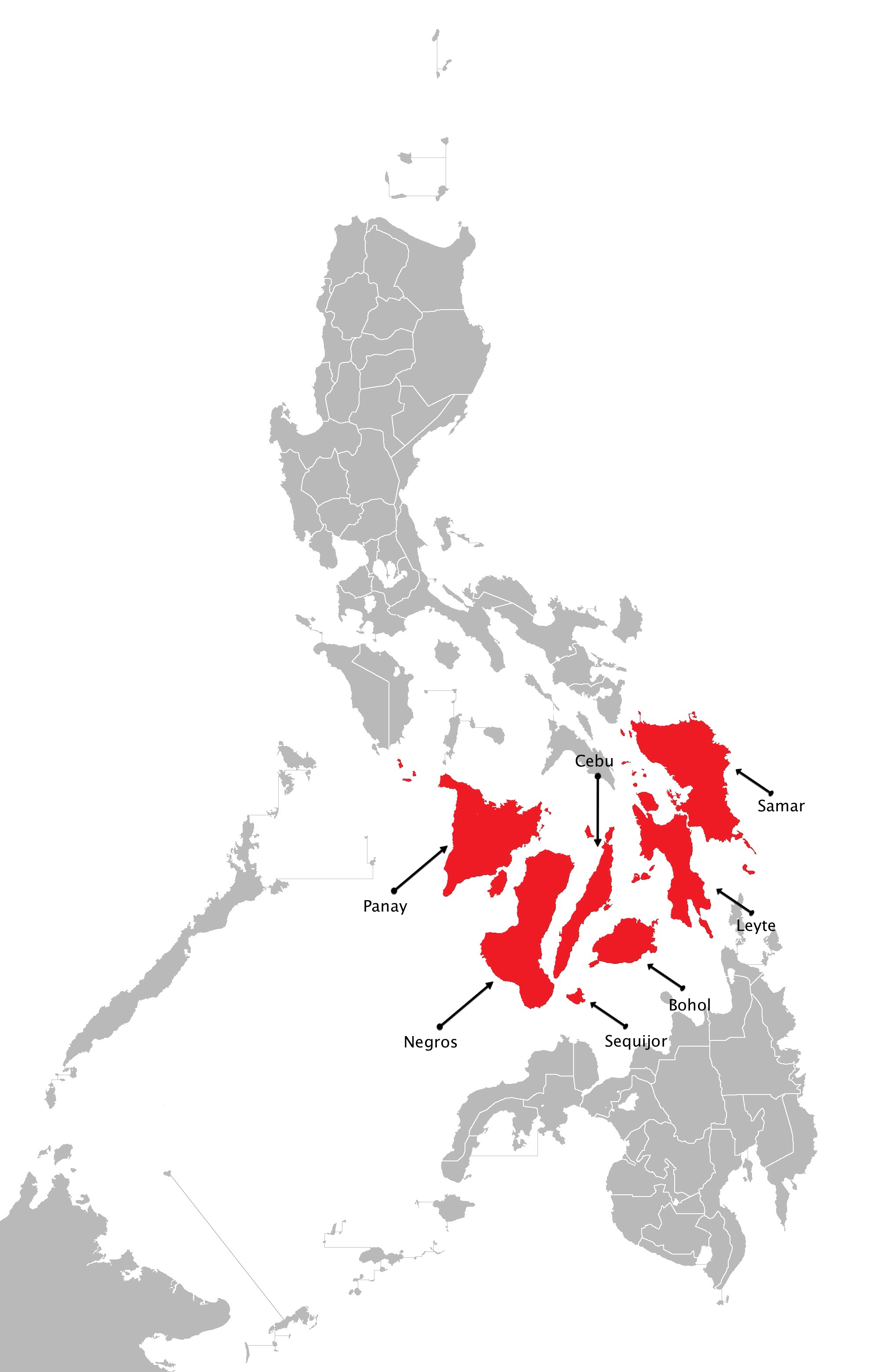
While we were flying into Cebu, it was obvious from our guidebook that we would want to get away from Cebu City as soon as we could. Should we head elsewhere on Cebu island? Hop over to a different one? But then… which of the surrounding islands to choose? Cebu is in the centre of the Visayas, a group of islands towards the south of the country, all of which sounded appealing in their own ways but tricky enough to travel between that we would have to just choose a few to hop between during our eighteen days in the country. Should we choose rugged Leyte, chilled-out Bohol, witchcraft-haunted Siquijor, beach-paradise Malapascua, dive-mecca Panglau…

The Visayas, the Philippines

The Visayas, the Philippines

Eventually we plumped for Negros, persuaded by the Lonely Planet’s introduction of, “if one island has it all”. With diving, hiking up the regions tallest peak, caving, snorkelling, beautiful, remote beaches, and, most appealing, a capitol (Dumaguete) lacking the usual chaos and hustle of Filipino cities and charmingly nicknamed The City of Gentle People. It looked just the place to stop, settle in, get our bearings and familiarise ourselves a little with Filipino culture.

Unfortunately, reaching Dumaguete also meant extending our already exhausting journey into an epic dash across the region, involving multiple taxis, long-distance buses, trikes and ROROs with increasingly exhausted kids in tow and without any guarantee of a bed at the end of our journey.

From start to finish, getting here took seventeen hours. It was sometimes fraught, occasionally baffling and not knowing if we would arrive too late to find a room or if we’d even get to somewhere with accommodation by the time we ran out of transport links added a constant anxiety. But everyone we met was friendly and helpful, and considering that we started the day unfamiliar with the Philippines, we got to see a broad range of places through various windows (and hanging off trikes) that have helped us get a sense of where we are.

And we made it.

Our first choice of hotel had rooms, is clean, comfortable and friendly, and positioned right on the promenade. As I came out to Janet where she waited by our overloaded trike still stuffed with bags and sleepy children and gave her the thumbs up, we all cheered, checked in at lightning speed, threw ourselves into bed with a real sense of exhausted a

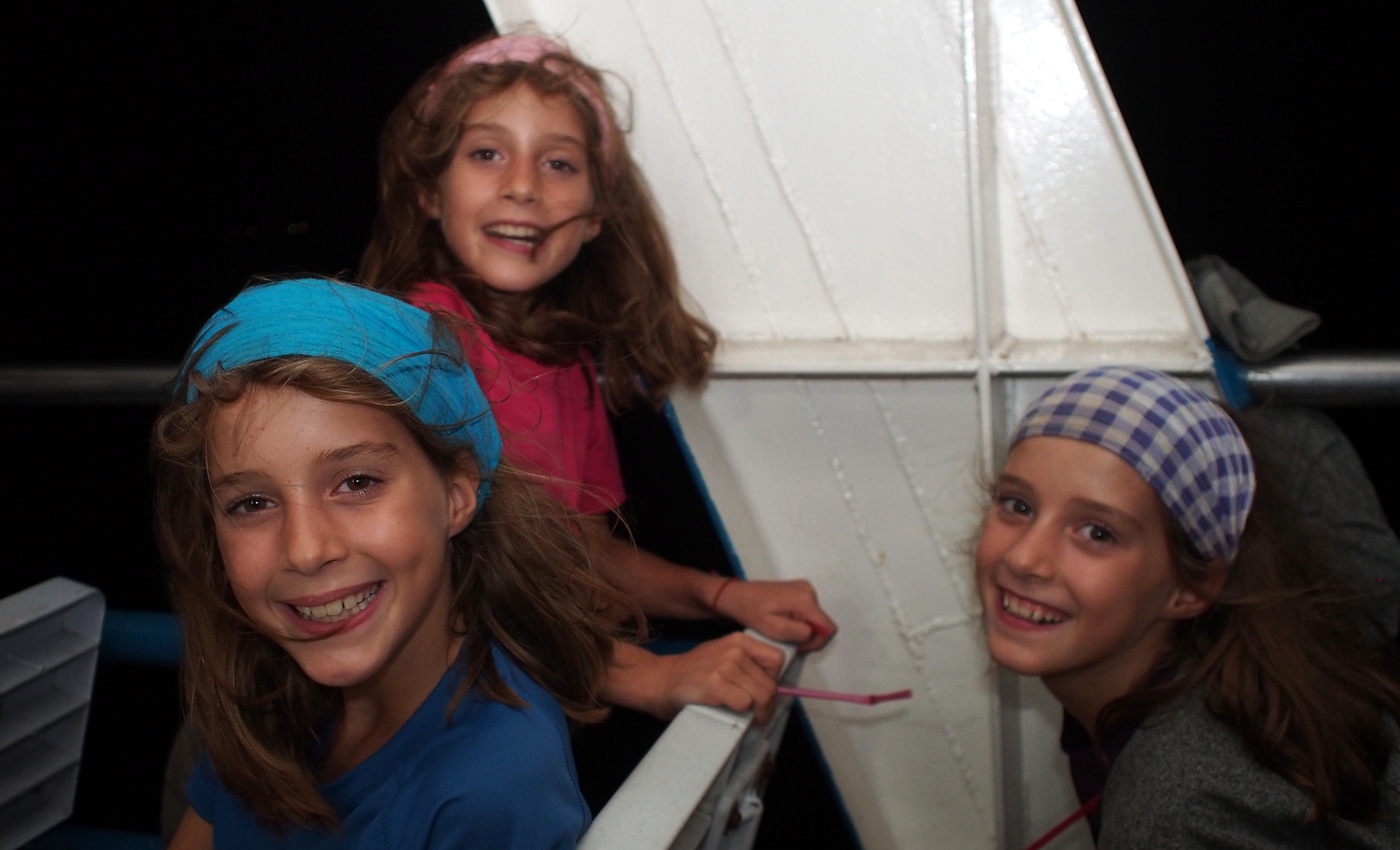
It's gone dark but we're still on the road (or the ferry in this case – from Cebu to Negros)

It’s gone dark but we’re still on the road (or the ferry in this case – from Cebu to Negros)

ccomplishment and had fallen asleep within moments.


Much of the thrill of travelling is to launch yourself into the unknown but to come through, tired but invigorated from having experienced the unexpected. It was exhilarating, winging our way here and I feel like we’re really travelling again after the comfortable modernity of Singapore, all the prebooking we had to do in Thailand and Malaysia and staying still for so long in Nepal.

But I think we’ll stay still for a day or two now.>

Our Singaporean Pit Stop

NB I wrote this post last week, in Singapore but was too busy shopping to finish writing it. Hopefully posting it from here in the Philippines isn’t too confusing…

This slideshow requires JavaScript.

Each country we’ve moved on to in our travels has been more modern, more developed, more reliable, richer, cleaner and safer than the last.

In the mountains of Nepal we were walking through regions where everything not made from wood or yaks had to be carried in on the backs of porters, and even in Kathmandu, all roads were single lane and buying anything above necessities was often a laborious task taking up much of the day, if they were available at all.

Arriving in Thailand seemed like being transported into the future – landing in Bangkok was like being swept into a sci-fi film, with its fast cars, neon signs and slick crowds… until we reached Malaysia, where everything again grew bigger and less ramshackle.

But now we have reached Singapore, and suddenly even Malaysia seems ramshackle.

We came travelling in part to escape our safe, predictable, comfortable Western lives. We wanted adventure. We wanted to experience life as the other half of the World’s population live it. And we have. But as well as being stimulating, travelling is also tiring. So arriving in what is essentially a modern Western city after six months on the road is rather a relief.

It’s a chance go shopping without endless haggling, take taxis without arguing over fares, to travel by easy-to-understand, punctual public transport, to enjoy people speaking perfect English, to drink the water and trust the food, to have your privacy respected by strangers, to trust the police. Not that there aren’t downsides: it’s expensive, commercial and scarily strict. But we’re only here for a week. Hopefully we can behave ourselves.

And the city itself is amazing. The skyline is a mosaic of skyscrapers, the monorail is clean and fast, the streets are clean, the people healthy-looking and well-groomed. Like Central London with the grubby bits erased.

So, for a brief few days before we fly out to the Philippines, we’re recharging our batteries and depleting our savings. We’re visiting sights (the zoo, Universal Studios, the ArtScience museum, the famous Raffles Hotel), gawping at the architecture, eating Western food, spending hours in the seemingly endless shopping malls refreshing our well-worn wardrobes, collecting a parcel in the only poste restante we trust in the region, buying gadgets… I’m even going to a game shop for an evening to indulge my hobby of wargaming.

I reckon I’ll be ready to leave here before long, but until then, we’re all enjoying the relief that is Singapore – a home from home while our money lasts.

My Foot

My Injured Foot

We’ve been to some dangerous places on this trip: Himalayan peaks, secluded jungles, lonely beaches, rocky reefs, pitch-black swim-throughs, remote diving trips, not to mention trying to negotiate third-World-city traffic… yet it was only yesterday that I had my first injury. In Legoland. That’s right. In possibly Asia’s safest, most engineered-so-not-even-toddlers-can-have-an-accident environment, I managed to slip and tear a big chunk out of my foot.

Walking along, carrying a big inner tube for one of the water slides, my knee inexplicably buckled, my foot slipped on the smooth stone and just as it was flying forward as fast as possible, crossed over from smooth flooring to (ironically) a rough, non-slip one. Unfortunately, it seems that non-slip surfaces, when attacked at high velocity by bare skin, turn from safety feature to cheese grater, leaving me in this case, several lumps of foot lighter.

Now my foot is all bandaged up and I’m walking with a limp… just as we’re arriving in Singapore where there’s nothing much else to do but walk around malls, parks, tourists sights, zoos and the like. And next we’re headed to the Philippines where I was really forward to diving with whale sharks. I really hope my foot’s healed enough to wear fins within the next few weeks.

Unfortunately, Singapore is by far the safest place we’ve visited on our travels. Which probably means I should be particularly careful. It seems that it’s the safe places you need to watch out for.


Food Glorious Food

Last night we arrived in Penang, the Pearl of the Orient, and, according to our Lonely Planet, home to the best street food in Asia.

We sampled a little last night, in Chinatown where we’re staying. The savoury dishes — Mee Goreng, Char Koay Tiaw, steamed ginger chicken, deep-fried crispy duck — were yummy, but the kids were less than impressed with the traditional Chinese desserts we bought. It seems that bowls of watery, sweetish soya milk with a sludge of tofu and pearl barley at the bottom just doesn’t cut it with British 8-year olds.

Today the epicurean adventure continues with breakfast at a locally-famous dim sum restaurant, then we’re going on a walking tour of the city to see the sights… and maybe check out a street food stall or two. Or ten.

An Andaman Coast Island Hopping Retrospctive

Andaman Coast Island Hopping Map

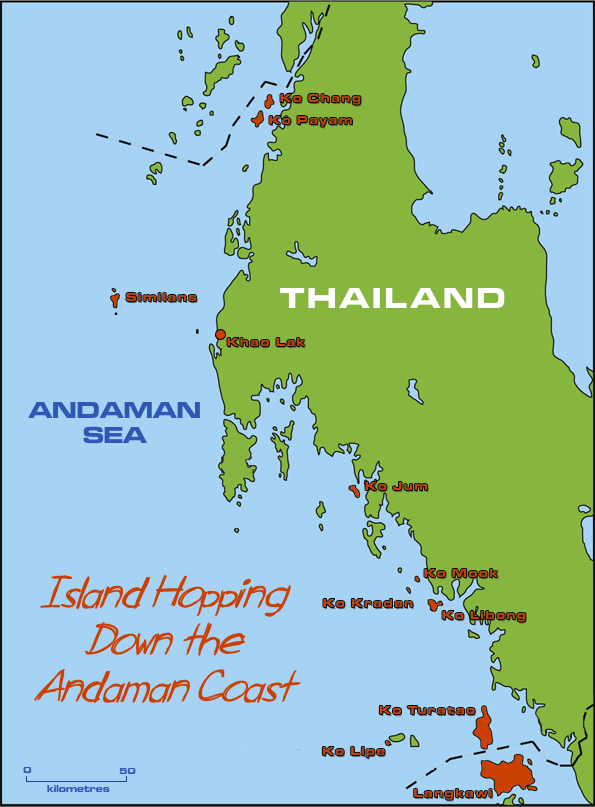
I realise now that we’re on our last Thai island that my plan for blogging about each island as we travelled down the coast was somewhat flawed. I kept putting off writing about the island we were on, not sure I could give a rounded view until the end of our four or five day stay… but then we’d be moving on and I’d be too busy packing up, making last-minute travel arrangements and squashing our entire family into whatever combination of longtails, ferries, buses, taxis or other transportation we invariably had too many bags to fit comfortably into. Then, at the end of the journey, we’d arrive somewhere new and there would be no time in the excitement of moving in, unpacking and exploring to write about the place we’d left behind.

Now we’re in Koh Lipe, our ninth island, and I haven’t written anything describing the island we’re on since Koh Chang (our first). So, while we’re still in Thailand, here’s a quick rundown of the impressions left upon me by the islands we’ve visited:

Koh Chang
Tucked away at the very northern end of the cost, within sight of Burma’s forbidden islands, Koh Chang has a ramshackle, laid-back charm. The sand is kind of muddy and the sea is both so salty it sometimes makes your skin sting a when you swim and too murky for snorkelling. And yet, with nothing much to do but wander the enormous beach or clamber in the rocks, stopping occasionally for a fruit shake to cool us down in a homemade-looking beach café, we really liked it here. No pretension. No pace. Just long-term, laid-back beach living.

Koh Payam (Ao Kwai)
Chang’s glamorous little sister. The beaches here are whiter, the resorts smarter, the sea clearer, he crowd younger, there’s even a road. But it felt shallower and less likeable than the island we’d just left. And it was noticeably more expensive. Still, we had some fun days out here, especially sea canoeing out into the bay to explore its rocky islets.

The Similans
I visited these islands alone, on a live-aboard dive trip visited while everyone else stayed in Khao Lak on the mainland. Ten dives in three days was exhausting but there was no denying the beauty of these remote, National Park Authority controlled islands, both above and below the water level. I swam with sharks, saw astonishingly-enormous manta rays, moray eels, stingrays, sea anenomes incredible coral and, of course, a technicolour spectrum of tropical reef fish. I did miss the whale shark that was everyone else on the boat’s highlight (I was in the toilet at the time) but that aside, it was brilliant. In retrospect, I think we should have gone back there as a family and camped on one of the open islands as it was too nice here not to have shared it with my family.

Khao Lak
Not strictly an island but we did spend quite a while here, and Janet and the girls loved it. Not sure if that was Khao Lak or the swimming pool in our resort, though, where the girls happily splashed about for up to six hours a day while Janet chilled out reading and surfing the web.

Koh Jum (Andaman Beach)
Reminiscent of Koh Chang, this was our favourite place on either coast at the time. The wide beach stretched for kilometres in both directions and, like Koh Chang, everything was built back behind the tree line, giving the illusion of strolling along the shore of a desert island. The food in our bungalows was excellent and the owners were lovely. It was a sad day when we left.

Koh Mook (Had Farang)
We’d been looking forward to this one; Koh Mook was one of Janet and my favourite places last time we were backpacking. At first we weren’t sure we should have returned. The quiet, open coconut plantation behind the beach had been swept away to be replaced by a brash package resort and the bay was now so crowded with longtails that you could only swim in a tiny roped-off area. It was upsetting. But the view was the same, and we spent much of our time at the edge of the bay, away from the Charie’s Resort. We also, found a really cheap, delicious place to eat a little inland and within days had settled into a happy routine of eating, beach time, homeschool and watching hermit crabs. Plus we had some great days out sea canoeing, wandering rubber plantations and visiting Emerald Cave.

Koh Kradan (Paradise Beach)
What an experience this island could have been! The sand is blisteringly white, the sea a magnificent turquoise, there are impressive coral reefs swimmable distances from shore; there can’t be many more picturesque places on Earth… and yet the resorts here spoiled it for us. Even though this island is supposedly part of the national park, the authority has sold off a strip along the coast, and the operations squashed into their narrow parcels of land seemed determined to make back every baht they had paid. The food was uninspired and overpriced everywhere, often twice the price it had been on Koh Mook, which we could see a few kilometres away. The bungalows were tightly packed and although it is undeniably beautiful, the beach is also narrow, meaning the holidaymakers were equally tightly packed along it. The best times we had here were trekking over the island through the jungle to as-yet-undeveloped Sunset Beach where locals have cleared the rubbish that washes up there and made it into strange sculptures along the shoreline.

Koh Libong (Had Thungyaka)
Phew! Arriving at Libong, it felt like I could breathe again. There was space on the beach, and between the bungalows. There were actually Thai people living there not just harried two week package tourists reading management books on sunloungers. And the food at Libong Beach Resort where we stayed was some of the best I’ve had in Thailand. Sure, the sea was very shallow, so you could hardly swim at low tide, but this quickly took over as our favourite island. And we saw dolphins.

Koh Tarutao(Ao Pante Malakka)
This was Janet and my dream island last time we travelled. We loved it so much here that when our cash ran out, we went back to the mainland, stayed just long enough to cash loads of travellers cheques and jumped back on the boat for another long stay. Tarutao is another national park island, this time is operated by the Park Authority itself. In the bay where we stayed (Ao Pante Malakka), there’s just one restaurant and you can either camp right on the beachfront or rent a neat little bungalow in the shady grounds behind. In the end we did both as our bungalow turned out to have bedbugs – Janet and the girls had over 300 bites between them after just one night. Elsewhere, getting eaten alive like that would have put us off but this was Tarutao so we switched to tents and stayed on. After all, unlike anywhere else we had been in Thailand, Tarutao hadn’t changed. How an island with a white-sand beach as wide as a football pitch and over three kilometres long (with another equally large a short rocky clamber south) has remained off the radar, I have no idea. Maybe it’s because there is nothing really to do there other than beachcomb, lie in hammocks, watch sunsets, swim, play frisby and occasionally wander away from the beach to eat, get a book from the library or climb the cliffs along an exciting jungle path for even more stunning sunset views. If you can muster enough energy, there are mountain bikes to rent (but be sure to check your brakes – the hills are steep), sea kayaks to rent and an old prison on the far side of the island to explore. But there’s no Western food, no wifi, no beach bars or dive schools, no beach furniture or touts trying to sell to the tourists. In fact, most of the tourists were Thai and judging by the crates of food, drinks, fish sauce and other supplies they brought, far too canny to buy overpriced tat from beach sellers. We spent ten days here; twice what we spent on most islands. We could happily have stayed much, much longer.

Koh Lipe (Had Pattaya)
I realise now we should never have returned to Lipe. Thirteen years ago it was an undiscovered jewel, known only to travellers who managed to get this far off the beaten track. It has one short road, a few scattered bamboo bungalow resorts and the clearest, brightest waters of anywhere I’ve ever been. Now the islanders have, after having the fishing rights restricted, been allowed to turn to tourism. They have sold off all the beachfronts, which are packed with bars, cafes and resorts. Music pumps out until the early hours, replaced during the day with the rumble of JCBs and pneumatic drills as yet more resorts are thrown up. The locals have that shrewd, hard look I’ve seen in other places where farangs outnumber the locals by a large margin. The sea is so crowded with longtails you can’t swim on our beach at all (apparently that’s where the first profits always go – they’re the ultimate status symbol for the Cho Lay people who live here). You can still see the beauty of the isand underneath. But that makes it sadder if anything.

And there you have it. Our Andaman coast island hop. After two solid month of beach bumming, tomorrow we head off to Malaysia… to another island: Langkawi.

(If you’re interested, you can click on the island names, above, to see all the posts we did manage to write while there.)